There are country houses that seem to expect you to arrive in a hushed state, as if you ought to apologise for your shoes before you have even left the car. Then there is Doddington Hall & Gardens, just outside Lincoln, which has all the red-brick confidence, long family history and architectural pedigree you could ask for, but without the theatrical strain of trying to prove it. It is grand, certainly. It is also refreshingly normal about the fact.
That is part of its charm. Doddington was begun in 1595, completed in 1600, and is linked with Robert Smythson, one of the great names of Elizabethan architecture. It was built for Thomas Tailor, registrar to the Bishop of Lincoln, and it has never been sold or cleared out since. In other words, this is not a grand house playing at history with a few borrowed chairs and a heroic gift shop. It is a place where history has been allowed to stay put.
A house that does not need to shout
The first thing Doddington gets right is scale. The Hall has presence, but it does not lunge at you. The mellow brick, the walled courtyards, and the clear symmetry of the Elizabethan design all do the work quietly. It looks settled. It looks as if it has no need to perform. That, these days, is almost radical.
Inside, the story becomes even better. The exterior remains largely Elizabethan, while the interiors took on a lighter Georgian character after John Delaval inherited the Hall in the 18th century and oversaw a major redecoration. So what you get is not a frozen museum piece, but a house that shows its centuries honestly. Gainsborough Old Hall offers another Lincolnshire example of a great house carrying several centuries at once. It has changed, but not in the usual stately-home way where every generation seems to have panicked and ordered a different wallpaper scheme from Europe.
More to the point, it still feels lived in. Doddington has been the family home of Claire and James Birch since 2006, and the wider estate has been developed in ways that help support the upkeep of the Hall and Gardens. That matters. A place like this survives because it is used, not because it is admired from a respectful distance by people holding guidebooks and mild disappointment.
The rare pleasure of beauty with a bit of ease
Many historic estates are beautiful in a way that asks quite a lot of the visitor. You are expected to be solemn, very interested in cornices, and grateful for a cup of tea that arrives looking defeated. Doddington takes a more sensible line. The estate has cafés, shops, walks, seasonal events and a farm shop, and the proceeds support conservation of the Hall and Gardens. So the day out feels rounded rather than dutiful.
That is what “without the fuss” really means here. It is not grandeur stripped of quality. It is grandeur stripped of stiffness. You can admire the Hall, wander the gardens, have lunch, browse the farm shop, and head out on an estate walk, all without feeling that you have violated some invisible code of aristocratic conduct. We should be thankful. The English country house has enough invisible rules already.
Gardens that feel designed for real people
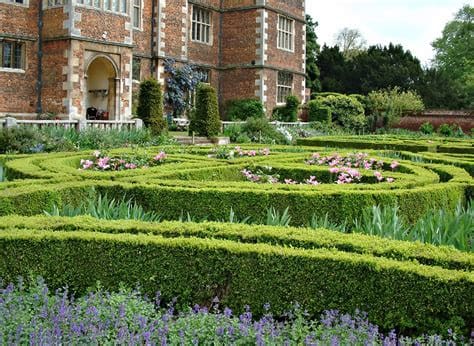
If the Hall provides the backbone of the visit, the gardens supply the warmth. Doddington’s gardens remain faithful to the original Elizabethan layout, with formal structure at the East Front and West Garden, then a looser, more romantic feel as you move into the Wild Garden. It is a smart sequence. The place gives you order first, then colour, then a bit of delightful untidiness. Rather like a good day out should.
The East Front is all clarity and control. Box edging and topiary follow the original walls, with the central view of the Hall left open. Four topiary unicorns stand in the forecourt, representing the Jarvis family crest. This could have been ridiculous. In fact, it works. Britain does topiary animals with a straight face, and perhaps we are right to.
The West Garden, reorganised in 1900 with help from experts at Kew, carries the season from April to September with wide borders and parterres full of colour. Crown imperials, Edwardian daffodils, white wisteria, peonies, alliums and the much-admired bearded irises all have their moment. It sounds almost offensively picturesque, but the formal framework keeps it from drifting into softness. There is enough structure to stop it becoming merely pretty.
Then there is the Wild Garden, which may be the most lovable part of the whole place. From February onward it runs through snowdrops, aconites, crocus, cyclamen, heritage daffodils and fritillaries before handing the season over to the irises. There are scented shrubs, old sweet chestnuts, a Temple of the Winds, a turf maze and even a “dinosaur’s egg” hidden in a tree. In other words, the garden understands that delight is not improved by being too dignified.
The kitchen garden is doing real work
One of the best things about Doddington is that the productive side of estate life is not treated as an afterthought. The Kitchen Garden, restored with support from The National Lottery Heritage Fund and brought back into production in 2007, grows fruit, vegetables, salads and herbs for the estate’s menus and farm shop. It uses crop rotation, biological controls and no-dig beds, avoiding chemical fertilisers, weed killers and pesticides.
This gives the estate a grounded quality that some historic properties miss. Instead of heritage being presented as a polite hobby for visitors, it feels tied to everyday use. Produce moves from the garden to the chefs and the shop. The place feeds people. That sounds obvious. Yet it is oddly rare to see heritage, hospitality and horticulture joined up so plainly.
For those of us who like gardens with purpose, this is one of the most appealing parts of the visit. A kitchen garden should not exist merely to be admired like a framed painting. It should be growing things people eat. Doddington seems to agree, which is encouraging.
More than a stately house day out
The estate has broadened its offer in a way that feels practical rather than desperate. If you enjoy this sort of full estate day, Belton House and Estate offers another strong Lincolnshire comparison. There are daily-opening cafés and shops, holiday cottages, cycling, free estate walks, and a calendar of events that keeps the place active across the year. The official Doddington Hall and Gardens website lists current opening details and events. The Hall and Gardens season in 2026 runs from 29 March to 27 September, with the Hall open on selected days and the gardens open more widely, while estate shops, cafés and walks operate daily. That spread makes Doddington much easier to visit than places that seem open only during a faintly ceremonial window on alternate Thursdays.
It is also well placed for a wider Lincolnshire day or weekend. Doddington sits roughly five to six miles west of historic Lincoln, making it easy to pair with time in the city without feeling as though you are doing military logistics. You can have your history, your garden, your lunch, and still get into Lincoln for a stroll later. Civilisation, in small doses, can be tolerated.
A modern estate with a long view
There is another layer to Doddington that makes it feel especially current. Through Wilder Doddington, the estate has committed to a long-term nature recovery project, described as a 400-year effort to bring more nature back to the land. Conventional farming on the estate ended after the final harvest in 2021, and the project now brings together habitat restoration, learning, public engagement and wildlife-focused experiences across a large part of the estate.
This matters because it stops Doddington being merely a handsome survivor from the past. It is also trying to work out what a historic estate should do now. Not just how it should look, but how it should live. There is a difference. Plenty of places can preserve a façade. Fewer can make a serious case for their future.
And Doddington does this without turning the whole experience into a lecture. You can engage with the wilding side through walks, safaris and learning opportunities, or you can simply notice that this is an estate trying to think beyond its lawns. Either way, the ambition is there. Quietly again, which is usually the more convincing way.
Why Doddington lingers in the mind
What stays with you after a visit is not any single room or border, though there are plenty worth remembering. It is the balance of the place. Doddington Hall & Gardens manages to be elegant without being cold, historic without being dusty, and visitor-friendly without becoming gimmicky. That mix is harder to achieve than it looks.
We often talk about heritage in extremes. Either it is a priceless national treasure, or it is a pleasant spot for tea and cake. Doddington sits in the far more interesting middle ground. It is a serious historic house. It is also a place where you can have a very good lunch, buy something decent from the farm shop, walk the estate, and leave feeling you have had a full day rather than an educational obligation. That is not a lesser achievement. It may be the smarter one.
Where the day settles
If you are after Lincolnshire at its most polished, but not over-polished, Doddington is an easy recommendation. The Hall has pedigree. The gardens have beauty and humour. The estate has enough life in it to keep the whole thing human. After more than four centuries, that is no small trick. Many places can do grandeur. Fewer manage warmth. Doddington, rather annoyingly for the rest of them, manages both.
If the gardens are the part of Doddington that stays with you, this flowering-plant collection is a useful follow-on for thinking about the sort of seasonal colour and planting combinations that make formal and informal gardens work so well together.