There are old houses that feel polished into submission. Then there are old houses that still look as if they remember things you do not. Gainsborough Old Hall belongs very firmly in the second group. It sits in Lincolnshire as one of England’s biggest and best-preserved medieval manor houses, and it does not need much help making the point. The place was built to impress in the late 15th century, and rather inconveniently for the rest of us, it still does.
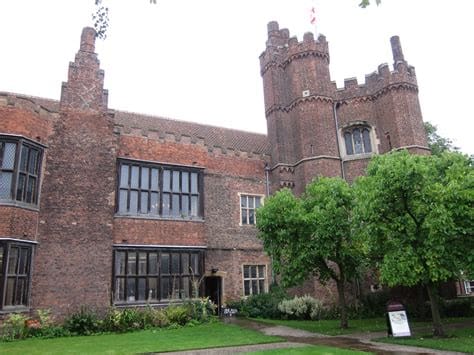
What strikes you first is not just age. England has plenty of that. It is the mix of materials and intent. Timber frame. Tudor brick. A tower that seems to say status in the plainest possible way. The surviving hall was built for Sir Thomas Burgh II, with work likely beginning in the later 1460s or early 1470s and continuing through the 1480s. This was not a modest country seat. It was a public statement in oak and brick from a man rising fast at court.
And that matters, because Gainsborough Old Hall is not just pretty. It explains something bigger about late medieval England. Houses like this were not only for living in. They were for staging power. For another Lincolnshire display of late-medieval brick, rank and ambition, Tattershall Castle makes a useful comparison. The central great hall, the flanking wings, the private apartments, the later brick tower and the huge kitchen complex all formed part of one long campaign of self-advertisement. Sir Thomas Burgh served four kings and ended up as 1st Lord Burgh under Henry VII. The building reflects that kind of ambition with almost touching honesty. It wanted to be seen. It still does.
The great hall is the obvious star. English Heritage highlights it today as one of the main reasons to visit, and quite right too. It keeps its medieval timber ceiling, and the scale still works on you in the old way. You can imagine the household ranked by status, meals staged as ritual, and every guest given the gentle reminder that the family at the high end of the room was not there by accident. Medieval architecture could be subtle, in the same way a trumpet is subtle.
But most of all, the kitchen tells the story. English Heritage calls the site’s kitchen complex the finest medieval kitchen complex anywhere in England, and that is not a line they hand out like leaflets on the pavement. The vast brick kitchen, with its surviving fireplaces and service rooms, shows how a house like this actually functioned. Grandeur is easy to admire when we are standing in the polished bits. The kitchen reminds us that grandeur had to be fed, heated, managed and scrubbed. It is one of the best surviving medieval kitchens in the country, which is another way of saying the servants’ world survives here almost as forcefully as the lord’s.
The hall also carries a useful amount of political gossip in its walls. It received Richard III in 1484. Then Henry VIII visited in 1541 with Catherine Howard. Those are not minor footnotes. Royal visits mattered because they confirmed a family’s standing and tied a house into national life. Gainsborough Old Hall was not tucked away from the story of England. For a time, it stood right inside it. That is part of the pleasure of being there. The building does not feel provincial. It feels connected.
Later, the house changed hands and changed character. In 1596 it was sold to the merchant William Hickman, who updated parts of it, especially the east range, with more brick, wider windows and a more modern domestic feel. That shift matters because it shows the hall adapting rather than freezing. Houses survive by changing. Doddington Hall and Gardens is another Lincolnshire example where a great house has kept evolving without losing its identity. The Hickmans also connect the site to the wider Lincolnshire story of religious dissent and New England. Official local heritage sources say Separatists were thought to have worshipped secretly here with William Hickman’s permission, and that their preacher, John Smyth, strongly influenced the Mayflower Pilgrims and later the Baptist tradition. In other words, this quiet Lincolnshire hall touches both national politics and Atlantic history, which is not bad going for one building.
Then came the long slide into practical use, which is where the hall becomes even more interesting. We are often told to love historic buildings at their most stately. Gainsborough Old Hall asks us to look harder. After the Hickmans moved out, the building stopped acting as one grand residence. Parts became workshops and businesses. Parts became tenements. The great hall became a theatre in 1790, then later a Corn Exchange, while other rooms served as Assembly Rooms, a Literary Institute and a Masonic lodge. English Heritage’s own history page is refreshingly blunt about all this. The hall did not spend its whole life being admired. It spent a good deal of it being used.
That is one reason the place has such a strong atmosphere now. It has not been preserved as a single frozen Tudor fantasy. It has had a full working life. John Wesley preached there in the 18th century. Families lived in cramped rooms above trade premises. The theatrical alterations of the 1790s remind us that every age is perfectly willing to remodel the past for its own purposes. We are not uniquely guilty. We are simply the latest in a long line.
The really heartening part of the story comes later. In 1949, responsibility for the building passed to the Friends of the Old Hall Association, an entirely voluntary group. Over the next two decades they raised substantial funds, restored the hall and opened it as a visitor attraction and community resource. In 1969 it passed into state care, and today it is managed by English Heritage. It is also Grade I listed, which places it among the country’s most important historic buildings. So the hall’s survival is not just a story of aristocrats and merchants. It is also a story of local effort, which is often how these places make it across the line from near-loss to public treasure.
If you visit now, the appeal is not hard to explain. The official English Heritage guide to Gainsborough Old Hall is the best place to check current opening details and events. You get the great hall, the domestic rooms, the kitchen, the tower and views across the town and the River Trent. English Heritage also lists current events on site, which says something useful about the place. It is not merely a relic with a till. It still works as a community space. That feels right. A house with this many former lives would have looked faintly embarrassed if reduced to standing still in silence.
What I like most, though, is the honesty of the building. Gainsborough Old Hall lets us see how power was built, displayed, softened, reused, neglected and then rescued. The Tudor brickwork matters, yes. It is handsome, self-conscious and full of intent. But the long memory matters more. This hall has hosted nobles, royalty, dissenters, preachers, traders, theatre-goers, tenants, volunteers and day-trippers. That is a better history than a neat one. It is messy, layered and lived in. Which, for England, is usually where the real value lies.
Where the centuries still answer back
Gainsborough Old Hall stays with you because it resists being only one thing. It is a late medieval status symbol. A Tudor survival. A Jacobean update. A dissenting refuge. A theatre. A civic building. A near-loss. A rescue job. And now, thankfully, a place we can still walk through and read for ourselves. We spend a lot of time talking about heritage as if it were fragile china. This hall feels different. It feels durable. Scarred, certainly. Altered, repeatedly. But durable. After more than five centuries, that may be the most impressive performance of all.
For a wider European comparison, this guide to Denmark’s Viking and medieval heritage offers useful context for how old halls, castles and trading towns still shape the character of places we visit today.