There are grander seaside places in Britain. They have bigger claims, louder branding and the sort of confidence usually found in estate agents. Cleethorpes is not quite like that. It does not need to be. It works in a quieter way.
That is the charm of it.
The seafront in Cleethorpes gives you something many resorts have spent years trying to redesign back into existence. It feels useful. It feels lived in. It feels like somewhere people actually go, not somewhere a brochure invented over a long lunch. Between the sandy beach, the prom, the pier, the boating lake, the miniature railway and the stretch of wildlife-rich coast beyond, you get a day that keeps improving as you walk.
Why Cleethorpes gets under your skin
What makes Cleethorpes Seafront work is balance. It has enough of the old British seaside to feel cheerful, but not so much that the whole place turns into a parody of itself. You get arcades, fish and chips, donkey rides and a lively central promenade. Then, only a little farther on, you get open sky, quieter paths, birdlife and that broad estuary light that makes everything seem a touch more thoughtful than it was five minutes earlier.
In other words, it is not one seafront. It is several moods stitched together. That is useful. Families can keep the children busy without much effort. Couples can wander off toward the boating lake and pretend they had meant to do something wholesome all along. Walkers get a proper stretch. Even people who claim they are “just here for some air” can usually be found later with chips in hand, staring nobly at the horizon.
Start at the pier and the central prom
The obvious place to begin is around Cleethorpes Pier and Central Prom. This is the bright, busy part. The beach here is wide and sandy, with a gentle slope that suits family beach time, paddling and the usual determined engineering works carried out with buckets. Behind it sits the traditional promenade, with arcades, bowling and crazy golf close by. It is straightforward, familiar and all the better for not pretending to be something more exotic.
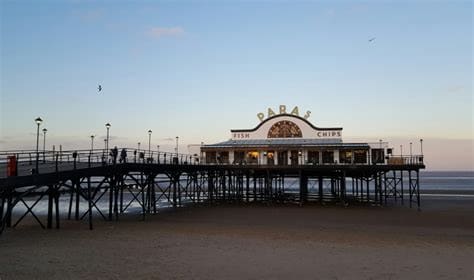
The pier itself is part of that long Victorian story the British coast does so well. Cleethorpes grew into a holiday resort in the nineteenth century, its pier opened in 1873, and the promenade followed in 1885. Ross Castle, the mock ruin that still watches over the seafront, dates from that same year and looks out across the Humber Estuary toward Spurn Point. It is the sort of detail that lifts a simple walk into something with a bit of memory to it.
These days the pier is not some dusty relic asking politely to be admired from a distance. It is very much in use, and it currently houses Papa’s Fish & Chips, which tells you something important about Cleethorpes. Even its heritage comes with vinegar. That feels correct.
The pleasure of walking south
But most of all, Cleethorpes improves when you keep moving.
Walk south from the busier central stretch and the place begins to breathe out. The boating lake area feels more open. The pace drops. The amusement-led mood gives way to something calmer, greener and slightly less sticky. Officially, the boating lake sits at the southern end of Cleethorpes next to a local nature reserve, and it is promoted as a good picnic spot. That undersells it a little. It is one of those places where a bench and a breeze can rescue an ordinary afternoon with suspicious ease.
This is also where the Cleethorpes Coast Light Railway comes into its own. It is one of Britain’s oldest seaside miniature railways, running since 1948, and it offers a two-mile return trip of about 30 minutes between Lakeside and Kingsway. The line links the boating lake area with the seafront and adds exactly the right amount of cheerful absurdity to the day. Britain, after all, is at its best when it treats miniature railways with full moral seriousness.
The railway is not just decorative, either. It is wheelchair friendly on most trains, with a specially built carriage for wheelchairs or mobility scooters. That matters. A good seafront should not be charming only for the fully mobile and mildly sunburnt.
More nature than you expect
One of the best things about Cleethorpes Seafront is that it can shift from seaside fun to proper coastal habitat without much warning. If you want to turn that into a longer coastal walk, the Skegness to Gibraltar Point route offers a wilder Lincolnshire shoreline farther south. That is part of what makes it feel bigger than a simple day-trip resort.
The Humber estuary is internationally important for wildlife, and the seafront area brings together beach, sand dunes, sand banks, saltmarsh, mud flats and wetland in close reach. For the working maritime side of the same coast, nearby Grimsby makes a natural companion stop. It is designated as both a Site of Special Scientific Interest and a Special Area of Conservation. In plainer English, that means the air here does not only smell of chips and sunscreen. It also belongs to a serious piece of coast.
That changes how the place feels, especially outside the busiest summer hours. You notice birds. You notice the wind more. You notice how the estuary light can make the prom seem theatrical one minute and almost meditative the next. After more than a century of classic resort life, Cleethorpes still has the good sense to leave room for curlew, knot, dunlin and the rest to get on with their day too. For another wildlife-led coast visit, the Donna Nook seal-season walk shows a very different side of Lincolnshire’s shore.
Simple pleasures, done properly
This is really the point. Cleethorpes does not win you over through spectacle. It wins by doing ordinary things well.
You can sit on the beach. You can walk the prom. You can ride the land train in summer. You can take the miniature railway. You can have fish and chips on or near the pier. You can drift toward the boating lake. You can look at Ross Castle and feel briefly cultural. None of this is revolutionary. It is simply a very solid use of a day.
And that, oddly enough, is what makes it memorable. Many seaside places now work terribly hard to become “destinations.” Cleethorpes, by contrast, remains a seafront. It knows what one is for. Fresh air. A walk. A treat. A sit down. Something for the children. Something for the grandparents. Something for the person who insisted they did not really want to come and is now looking at paddle water with suspicious contentment.
It is friendlier than some resorts manage
There is also a practical kindness to the place. The official Cleethorpes seaside resort guide is useful for checking current access, parking and visitor information. North East Lincolnshire Council lists free beach wheelchairs available every day from the Tourist Information Centre opposite the pier, says the Lollipop Land Train is wheelchair accessible, and notes Blue Badge parking across the promenade with beach access ramps at several points close to the sand. That is the kind of detail that shapes a real day out, instead of merely decorating a tourism page.
Getting there is fairly straightforward too. The main railway station sits on the seafront at North Promenade, and parking is available along the promenade and nearby, though it fills quickly in peak periods. Dogs are restricted on the main two beaches from Good Friday to 30 September, but the stretch from Cleethorpes Leisure Centre toward Humberston Fitties is dog-friendly year round. In other words, a little planning helps, which is true of most worthwhile British excursions and nearly all British parking.
One thing to know before you go
At the time of writing, Pier Gardens is fully closed while major renovation work takes place. The council says the closure includes the gardens and connecting paths from Central Prom. That does mean part of the usual seafront picture is currently in transition. Still, it is better to know that before you arrive than to discover it mid-stroll while pretending not to be mildly annoyed.
Even with that work under way, the wider seafront still offers more than enough. The beach remains the beach. The prom still does its job. The boating lake still slows you down. The railway still trundles along with admirable confidence. The sea air, rather selfishly, continues as normal.
A shore that quietly earns a return visit
Cleethorpes Seafront is not trying to astonish you. That is part of why it succeeds.
It gives you a proper British seaside day with enough colour and movement to feel cheerful, then adds open estuary views, wildlife, heritage and just enough calm to stop the whole thing becoming exhausting. Instead of choosing between family fun and a decent walk, it offers both. Instead of forcing you into a fixed version of a day out, it lets the day shift as your mood shifts.
You start with a beach and a promenade. You end with a better mood than you expected.
Which, for a day by the sea in Britain, is not a bad result at all.
If Cleethorpes is one stop on a broader break, this practical England trip-planning guide is handy for keeping coastal days, town visits and travel time in sensible proportion.