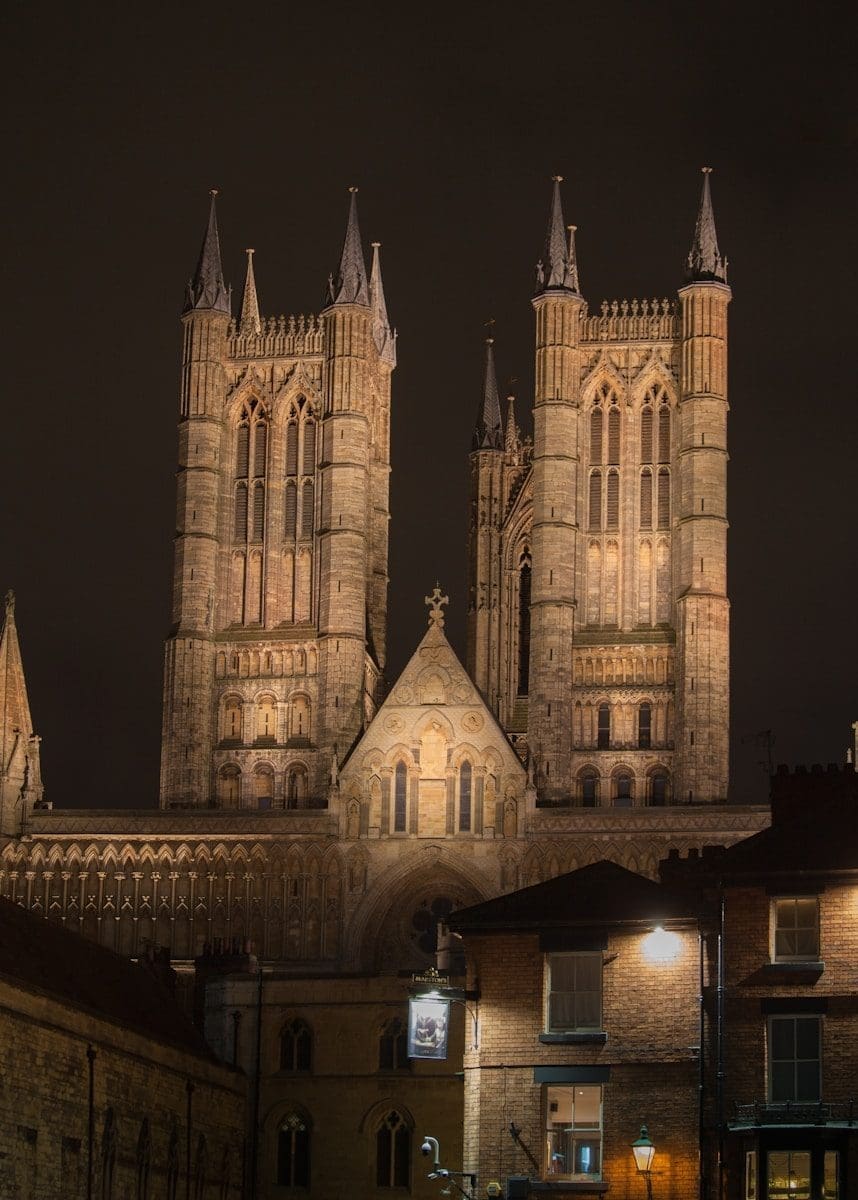
Lincoln Cathedral Does Not Sneak Up on You
Lincoln Cathedral is not the sort of building you suddenly notice.
It appears first as a shape on the skyline. Then a tower. Then a full stone giant. Then, once you get close, a wall of carved detail, arches, glass, and old ambition.
It is the kind of place that makes us look up before we remember to speak.
That is no small thing. We live in an age where most buildings seem designed to be ignored until the invoice arrives. Lincoln Cathedral is different. It demands attention, but not in a loud way. Its neighbour, Lincoln Castle, gives the hilltop a second landmark. The cathedral simply stands there, enormous and calm, as if it has seen enough centuries to know we will get the point eventually.
Why Lincoln Cathedral Is Famous
Lincoln Cathedral is one of the great Gothic buildings of Europe.
It was first commissioned after the Norman conquest, and for centuries it has dominated Lincoln’s skyline. At one time, after its spire was added, it was believed to be the tallest building in the world. That is quite a claim for a city that now mostly has to explain to visitors where to park.
The cathedral is famous for its scale, its Gothic architecture, its stained glass, its libraries, its carvings, and the Lincoln Imp.
The Imp is small. The cathedral is not. This is part of the fun.
Visitors often arrive expecting a grand church. They get that. But they also get hidden details, odd corners, stories in stone, and a sense that the whole building is much more alive than it first appears.
The First View Is Half the Visit
You can see Lincoln Cathedral from miles around.
That matters. In Lincolnshire, where land often lies low and skies take up most of the room, a building like this becomes a landmark in the old sense. It is not just something to visit. It is something to steer by.
Approaching Lincoln from the surrounding countryside, the cathedral rises above the city like a fixed point. This is part of its power. It does not belong only to the close streets around it. It belongs to the wider county view.
Once you are in Lincoln’s Cathedral Quarter, the mood changes. Streets narrow. Stone appears. Shops and cafés sit in old buildings. The cathedral becomes less distant and more physical. You start to feel the size of it.
Then you step inside.
And yes, it is as big as it looked.
Inside the Cathedral
The interior is grand, but it is not just grand.
That is important. Some big buildings are impressive in a cold way. They make us admire them, then leave. Lincoln Cathedral has more warmth than that. The nave is vast, but the details pull us closer. There are carvings, windows, patterns, chapels, and small surprises tucked into the stone.
The light changes everything. On a grey day, the building feels solemn. On a bright day, the glass and stone soften. Either way, the place has atmosphere.
This is where it helps to slow down. Do not try to “do” the cathedral too quickly. That is a very modern mistake. We rush in, look at the famous thing, take a photo, and move on as if history is a checklist.
Instead, walk the nave. Look back. Look up. Find the smaller details. Let the building be a building, not just content for your phone.
Radical, yes.
Finding the Lincoln Imp
The Lincoln Imp is one of the cathedral’s best-known details.
The little stone figure sits high inside the building and has become a symbol of the city. The story, as stories tend to do, involves mischief, angels, and someone being turned to stone. Quite firm behaviour from the angel, but standards were different then.
Children enjoy the hunt for the Imp. Adults do too, though we pretend we are above such things.
The Imp works because it adds a human scale to the cathedral. The building is enormous and serious. The Imp is small and cheeky. Together, they make the place feel less remote.
That is the secret of many great historic buildings. The scale pulls us in. The odd details keep us there.
Tours Make a Real Difference
Lincoln Cathedral is worth exploring on your own, but tours can add a lot.
Floor tours help make sense of the building’s long story. Roof tours and tower tours, where available, take us into parts of the cathedral we would never understand from ground level. They also remind us that buildings like this are not just designed. They are made. Stone by stone. Beam by beam. Century by century.
There is something humbling about seeing the craft behind the beauty.
The cathedral was not created by one neat burst of genius. It grew, changed, broke, repaired, and adapted. It is still cared for now. That ongoing work is part of the story.
We tend to think of heritage as something finished. Lincoln Cathedral proves the opposite. Old buildings need constant attention. Very old buildings need constant attention and, one suspects, a strong cup of tea.
The Cathedral Quarter
The area around the cathedral adds a great deal to the visit.
Bailgate, Castle Hill, and Steep Hill make the whole place feel like a proper historic district, not just a monument dropped into town. Lincoln Castle stands close by, which gives visitors one of the strongest heritage pairings in the country. Castle and cathedral. Power and faith. Stone and more stone. Lincoln did not under-order.
The nearby streets have cafés, pubs, independent shops, and places to sit. That matters, because a cathedral visit is better when it is not rushed. See the building, then have lunch. Walk a bit. Go back and look again from another angle.
This is not wasted time. It is how places begin to settle in the mind.
Is Lincoln Cathedral Good for Families?
Yes, with a little pacing.
Children may not want a two-hour lecture on Gothic vaulting. Few adults do either, if we are honest. But the cathedral has enough scale, stories, and hidden details to keep families interested.
The Imp gives younger visitors a clear thing to find. The Discovery Centre and exhibitions help make the history more accessible. The sheer size of the building does the rest.
The key is not to make it feel like school. Let children notice things. Let them ask strange questions. Old buildings are very good at producing strange questions.
And if attention begins to fade, step outside and look back at the front. Sometimes the best way to understand a building is to leave it for a moment.
Best Time to Visit
Lincoln Cathedral works in every season.
In spring and summer, the area feels lively, with more daylight for walking around the city. Autumn brings softer light and fewer crowds. Winter gives the cathedral a colder, more dramatic beauty. It also gives us the chance to say “atmospheric” when what we mean is “bracing”.
Weekdays are often calmer. Event days can be busier but may add extra interest. As always, check current opening times and tour availability before travelling.
Comfortable shoes help. Lincoln is built on a hill, and the cathedral sits at the top like a prize for those who have earned it.
Is It Worth Going Inside?
Yes.
Seeing Lincoln Cathedral from outside is wonderful. But going inside changes the visit. You feel the scale properly. You see the craft. You notice the small things that do not show from the street.
It is easy to think we know a landmark because we have seen photos. We do not. A photo cannot give us the weight of stone, the height of the nave, or the hush that settles in a great building.
Lincoln Cathedral is not just a sight. It is an experience of space.
That sounds grand. It is also true.
Stone, Sky and a County Looking Up
Lincoln Cathedral remains one of Lincolnshire’s great landmarks because it still does what it was built to do.
It draws the eye. It lifts the view. It makes us pause.
You do not need to be religious to feel the power of it. You do not need to know every date. You only need to stand near it for a moment and look properly.
The building will do the rest.
It has had centuries of practice.
If Lincoln Cathedral is part of a wider trip, this practical England itinerary guide is useful for fitting major historic landmarks into a route without letting travel logistics take over the day.