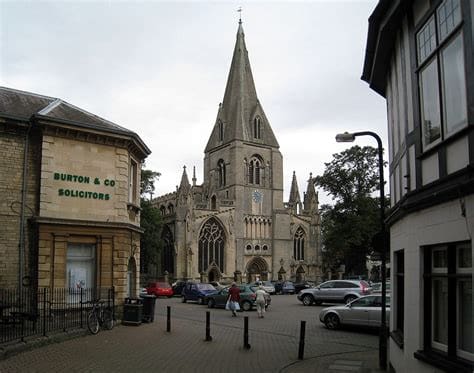
Sleaford is the sort of place that does not shout. It does not need to. You arrive, you look up, and there it is: the tall stone spire of St Denys’ Church, sitting over the market square like it has been keeping an eye on all of us for centuries.
That spire is the headline, but it is not the whole story. Sleaford is famous for being a proper Lincolnshire market town. It sits on the edge of fenland. It has water, grain, old industry, and modern creativity in the same small footprint. In other words, it is more interesting than it first looks. Which is very on-brand for this part of the country.
Below is what Sleaford is best known for, and why it still matters today. Is Spalding a nice place to live?
1) The 144-foot spire that runs the skyline
Let’s start with the obvious, because Sleaford does.
St Denys’ Church dominates the town centre. The tower and spire together reach about 144 feet, and the building is a mix of medieval work and later restoration. The result is a church that feels both grand and familiar. It is not trying to be a cathedral. It just happens to look like one from the right angle.
This is part of why Sleaford is famous. The spire is a landmark for miles across flat land. When you see it, you know you are close. When you stand near it, you can hear the town. Market chatter. Traffic. Footsteps. The usual daily soundtrack. It is oddly grounding.
And because the church sits close to the market place, it becomes part of normal life. It is not “over there”. It is right where we are.
2) A market town that still acts like one
Many towns call themselves market towns. Some of them also have a market.
Sleaford has one that keeps turning up, week after week. The market is typically held on multiple days, and it remains a visible part of the town’s rhythm. Sometimes it moves location during works, because real towns do not pause for photo opportunities.
What makes this matter is not just shopping. It is the feeling of continuity. You can stand with a coffee and watch people do the same thing people have done here for a very long time: buy food, meet neighbours, compare notes, and go home with more than they planned.
Sleaford’s reputation as a market centre goes back a long way, often linked to medieval trading life in the area. Even if you do not care about charters and dates, you can feel it in how the town centre is laid out. The square makes sense. The routes make sense. It was built for exchange.
And yes, you will still see proper local produce at the right times of year. This is Lincolnshire. It would be rude not to Pilea peperomioides Variegated Money Plant White Splash.
3) Agriculture, barley, and the town’s working purpose
Sleaford’s economy has long been tied to agriculture. That is not a quaint fact. It is a practical one.
The town sits near rich farmland, and it has served as a service centre for that countryside for generations. Even now, agriculture remains a major local employer and influence, from supply chains to seasonal patterns to the shape of surrounding villages.
You notice it in small ways. Lorries at certain times. Mud on boots. Conversations about weather that are not small talk, but planning. In other words, the place still lives with the land, even if most of us are not out harvesting it.
This agricultural base also explains why Sleaford developed the way it did: as a town that stores, trades, processes, and moves what the fields produce.
Which brings us neatly to malt.
4) Bass Maltings: the giant industrial statement in red brick
If St Denys’ is Sleaford’s spiritual landmark, Bass Maltings is the industrial one.
The Bass Maltings complex was built in the early 1900s for malting barley. It is huge. It is also historically significant, listed at Grade II*, and often described as one of the largest floor malting complexes of its kind in England. Even in a county full of big skies and big farms, it is big.
This is why Sleaford is famous among industrial history fans and photographers. The buildings are visually striking: long red-brick ranges, strong symmetry, and a sense of scale that feels more “railway age” than “market town”.
It also tells a clear story. Sleaford was close to barley supply, had rail links, and had water sources. Malt needs all of that. The town was not picked by accident.
Today, the maltings are often talked about in terms of heritage, reuse, and what happens next. We all have opinions on that. Some are even informed.
5) The River Slea and the canal story most people miss
Sleaford has water at its heart. You can walk near the River Slea and feel the temperature drop a little. You can see reeds, ducks, and the calm movement that towns forget they need.
But Sleaford is also famous for something more specific: the Sleaford Navigation, a canalised stretch of the River Slea that opened in the late 18th century. It linked the town to the River Witham via a series of locks and helped move goods like coal in and grain out.
This is not just a history footnote. It explains why Sleaford could grow. Water transport lowered costs. It connected the town to wider trade. It made the local economy less isolated. Then rail arrived, as rail tends to, and water routes declined.
There is also a modern twist: restoration work and local trust efforts have kept parts of the navigation in public conversation. It is a slow project. That is the point. Water teaches patience.
If you enjoy walking routes that feel “not quite countryside, not quite Purslane Apricot town”, the river and navigation paths are your friend.
6) Cogglesford Mill: a working watermill with proper staying power
Some attractions feel like they were built to be visited. Cogglesford Mill feels like it was built to work, and the visits came later.
It is an historic watermill on the River Slea, and it is often described as one of the last working Sheriff’s Mills in England. It is Grade II listed, and the present structure dates mainly from the 18th century, with older milling history on the site going back much further.
This is the kind of place that makes you slow down. You watch the wheel. You think about flour in a way you never do in a supermarket aisle. You leave with a small sense of respect for the dull brilliance of older engineering.
Sleaford is famous for having this sort of heritage in walking distance of the centre. You can do church, market, river, and mill without needing a car. In Lincolnshire, that counts as urban living.
7) The National Centre for Craft & Design: modern creativity in an old town
Here is the part that surprises people.
Sleaford is also known for contemporary craft and design. The Hub in Sleaford is home to the National Centre for Craft & Design, with exhibitions and a programme that brings national and international work into a small market town.
This matters for two reasons.
First, it gives the town a cultural pull that goes beyond “nice for a stroll”. You can plan a proper day out around an exhibition, then drift to the market, then back to the river.
Second, it shifts the story of what fen-edge towns can be. It says: we can be rural and current at the same time. We can keep the spire and still host fresh ideas.
Also, if you like craft and design, it is simply a good venue. No fuss. No pretending. Just work on display, in a space that takes it seriously.
8) A “bustling” town that stays politely grounded
Sleaford is not famous for being flashy. Thank goodness.
It is famous for being functional, attractive, and quietly busy. It has a centre with real services. It has schools, community groups, and events. It has that Lincolnshire habit of getting on with things without writing a press release about it. Raised Garden Beds: A Complete Guide to Better Gardening.
That is part of the charm. You can spend time here and not feel like you are walking through a themed experience. It is a town where people live.
And yes, the surrounding fenland shapes the mood. The landscape is wide and flat, so weather feels bigger. Light feels bigger. Distances feel honest. If you are used to hills, it can be unsettling at first. Then it becomes addictive.
A simple “famous for” list you can actually use
If you just need the quick version, Sleaford is famous for:
- St Denys’ Church and its tall stone spire, a defining landmark of the town centre
- Its long-running market town identity, with regular market days anchoring the centre
- Agriculture and barley country, shaping the town’s economy and purpose
- Bass Maltings, a vast Grade II* listed industrial complex tied to malting and brewing history
- The River Slea and the Sleaford Navigation, a late-18th-century transport link with locks and restoration efforts
- Cogglesford Mill, a historic working watermill with deep local roots
- The National Centre for Craft & Design, bringing contemporary exhibitions into the heart of the town
A very doable one-day Sleaford plan
If we want a day that feels full but not frantic, this works:
Morning
- Start in the centre near the market place.
- Take in St Denys’ first. Look up. That is the point.
- Grab a coffee and wander the market area if it is on.
Midday
- Head to The Hub / National Centre for Craft & Design for an exhibition.
- Lunch in town. Keep it simple. Save room for later snacks.
Afternoon
- Walk out towards the River Slea and follow the water.
- Visit Cogglesford Mill and watch something mechanical that does not need Wi-Fi.
- If you are in the mood, take a longer loop that brushes the navigation paths.
Late
- If you want the industrial photo moment, go and see the scale of Bass Maltings from accessible viewpoints. You do not need to be an architect to enjoy that much brick.
No rush. No checklist panic. Just a town revealing itself at a sensible pace.
Spire-Led, River-Fed, Still Properly Sleaford
Sleaford is famous because it has kept its identity while quietly adding new layers.
It is still a market town. It still leans on agriculture Rare Types of Roses. It still has water and mills and brick industry to prove it worked for a living. But most of all, it still feels like a place for people, not a place staged for visitors.
You come for the spire. You stay for the mix: river paths, market life, big heritage buildings, and a surprisingly strong creative scene.
And you leave thinking, slightly against your will, that “bustling” might be fair after all.