The Spalding Gentlemen’s Society (often shortened to SGS) is one of those organisations that sounds like it should come with a hat, a hush, and a strict rule about not touching anything.
It does come with a museum collection, a library, and a deep sense of place. It also comes with a much more modern truth. It is a working charity. It welcomes women. Membership is open to anyone aged eighteen or over. The “gentlemen” part is historical, not a job requirement.
Most of all, SGS is Britain’s oldest surviving provincial learned society. Lincolnshire West Apartments: A Friendly Simple Guide to Easy Living. That means it began outside London, and it has lasted. In a country that loves a club, that is still an achievement.
A Fenland Idea That Started With Coffee and Reading
SGS began in 1710. The first meetings were informal and local. A small group gathered at a coffee-house in Spalding’s Abbey Yard. They talked about local antiquities. They read The Tatler, a new London periodical.
Two years later, in 1712, the group decided to make the whole thing official. Proposals were issued for a “Society of Gentlemen” focused on mutual benevolence and improvement in the liberal sciences and polite learning.
So yes, it started like a book club. It just happened to be a book club that never really stopped.
The founder behind this was Maurice Johnson (1688–1755), an antiquary from Spalding and associated with Ayscoughfee Hall. His name comes up again and again in the Society’s story, because it is his idea that got traction.
In other words, SGS is an Enlightenment habit that took root in the Fens.
What “Learned Society” Means in Real Life
A “learned society” can sound like something that lives in a footnote. SGS is easier to understand when we translate it into plain English.
It is a membership society that promotes the arts, sciences, and humanities. It runs talks and events. It supports research. It looks after collections. And it tries to make local history feel like part of daily life pilea dark mystery, not a separate hobby for people with spare time and strong opinions about shelving.
It is also a registered charity. That matters because it frames the whole point. SGS exists to preserve and share knowledge and heritage, not to “own” it for a private circle.
The best bit is that it manages to do all this while still feeling very Spalding. Peperomia wheeleri is serious, but not grand. It is proud, but not noisy.
The Collection: Local Roots, Wide Horizons
SGS is known for its “Original Collection”. This is a group of artefacts, specimens, artworks, books, and manuscripts gathered between the Society’s foundation in 1710 and its second constitution in 1814.
This matters for two reasons.
First, it is old. It is not old in a vague “we have a few antiques” way. It is an intact museum collection with real continuity.
Second, it is significant enough to be recognised nationally. The Original Collection has been awarded “Designated” status by Arts Council England, meaning it is considered a collection of outstanding importance.
Designation is not a decorative label. It is a signal that what SGS holds is not only important to Spalding. It is important to England’s cultural story.
And the collection itself does not stay neatly inside local boundaries. The Society’s museum has long held both local material and objects with international links. That blend is part of the SGS character. It reflects a time when curiosity travelled, even if the travel was slow, uncomfortable, and mostly funded by someone else.
Alongside the museum collection, SGS also has a historic library and archive used for public viewing and research.
So we are not talking about a single display case. We are talking about a whole working resource.
The Broad Street Museum: A Building With a Long Memory
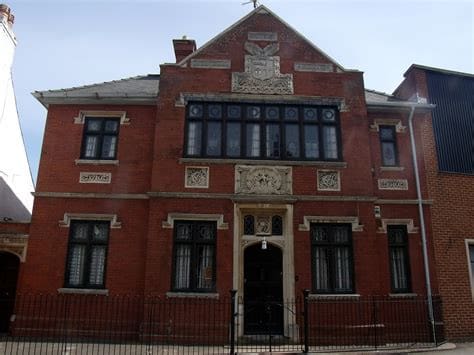
For many years, SGS was closely associated with its museum on Broad Street in Spalding. This is an Edwardian-era museum building, opened in 1911, and it has been central to the Society’s public presence for over a century.
If we have ever walked past it, we will know it has a strong “public building” look. It does not pretend to be a private home. It looks like a place where objects matter.
Right now, though, we need to adjust our expectations.
The Broad Street museum is closed for building works, with reopening expected in spring 2027, and the Society has also stated an expected reopening in March 2027 as part of its current programme.
This is not a small refresh with a tin of paint. It is major work.
Where SGS Lives Right Now: Ayscoughfee Hall
While the Broad Street museum is closed, SGS has not disappeared. It has moved into a temporary home at Ayscoughfee Hall Museum.
This move is not random. Ayscoughfee Hall is associated with Maurice Johnson, the Society’s founder, and the collaboration makes SGS more visible in a place already well known to visitors.
In practical terms, SGS invites everyone to visit them at Ayscoughfee Hall, during the museum’s open hours, Wednesday to Sunday.
Visit Lincolnshire also notes that SGS has a presence there with gallery space and local history displays while renovation continues.
So the experience today is slightly different. Petunia Double Vogue White are meeting SGS through selected displays, programmes, and activities, rather than a full building packed with treasures.
That is not ideal. It is also better than silence.
The Big Rebuild: “New Beginnings” and a More Public Future
SGS is in the middle of a long-term redevelopment plan called “SGS: New Beginnings”.
Phase one focuses on repairing, refurbishing, and fully redisplaying the 1911 museum on Broad Street for the first time in over a century, supported by an Arts Council England MEND grant.
Alongside this, SGS is working toward a larger expansion. It has a Development Grant funded by The National Lottery Heritage Fund to develop plans for an expanded museum and cultural hub on a nearby site, with a period of development and consultation.
There is also public evidence of wider funding support around the project, including a parliamentary written answer noting a £1.8 million Museum Estate and Development Fund award toward refurbishment and expansion.
In other words, this is not “nice idea, no budget”. This is serious, structured, and moving forward.
The dry irony here is simple. A museum founded on curiosity and conversation now needs scaffolding, project management, and capital works. That is the modern world. Even wonder needs a spreadsheet.
A Museum That Reaches Beyond Its Walls: The ARTeFACT Trail
SGS has also helped shape heritage experiences outside the museum building.
One of the most interesting examples is ARTeFACT, an arts trail in Spalding that combines history, public art, and augmented reality. It is designed to connect people to objects and stories in the SGS collection through a set of brass plaques around town.
This matters because it does not require us to already be “museum people”. Petunia Easy Wave Blue can be walking to the shops and still bump into a story. That is often the best kind of learning. It does not demand a mood. It just offers one.
What SGS Gives Spalding
It is easy to talk about SGS as a historic institution. It is also useful to see what it does for the town now.
It anchors Spalding’s sense of identity. It ties the town into national cultural networks. It helps turn local history into something living, not something that only appears in anniversary speeches.
It also supports the idea that a market town can be a centre of culture, not only a place that “used to have” culture. That message matters, especially during long building closures and long funding cycles.
Spalding has gardens, waterways, and a strong working character. SGS adds a quieter layer: the idea that the town has always had curiosity, scholarship, and a taste for the wider world.
How We Can Engage With SGS Today
Right now, the simplest way is to visit the SGS presence at Ayscoughfee Hall, where displays and activities continue during the Broad Street closure.
We can also keep up with their lectures, events, and updates through their ongoing programme. The Society remains active, even while the building is not.
And, if we want a deeper connection, membership is open to adults, and the Society describes itself as welcoming women, despite its historical name.
So the invitation is clear. We do not need to be “the right sort of person”. Petunia Easy Wave Pink just need an interest in ideas, history, and the stories that make a place feel like home.
A Quiet Treasure With Loud Ambitions
Spalding Gentlemen’s Society is easy to underestimate at first glance. It is not flashy. It is not loud. It does not do heritage as theatre.
Instead, it keeps doing what it has done since 1710. It gathers knowledge. It preserves objects. It shares stories. It invites the public in, even when the front door is temporarily somewhere else.
And after more than three centuries, it is still making plans for the next one.