Some places celebrate spring with a polite nod and a cup of tea. Spalding, in South Holland, Lincolnshire, chose the louder option: a full parade of floats covered in flowers, rolling through town like a moving garden. The Spalding Flower Parade was held every year from 1959 to 2013, then returned in 2022 and has been held each year since.
If you grew up in the area, you may remember the day as part festival, part reunion, and part traffic problem. If you did not, it can sound almost unreal: floats decorated with huge numbers of flower heads, bands and performers, and crowds that once topped 100,000.
And yet, it makes perfect sense in the Fens, where the landscape is wide, flat, and practical. This is a place that has always understood how to make something beautiful out of hard work.
Why Spalding Became a Parade Town
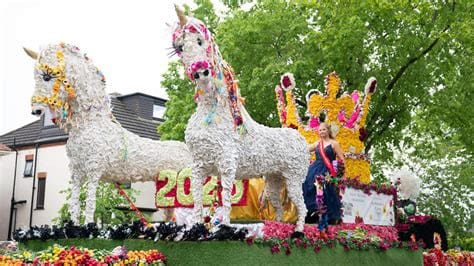
The parade is not a random bit of pageantry. It is rooted in the local bulb industry and, in particular, tulips.
Tulip bulbs are grown for what sits underground. To help the bulb, growers remove the flower heads. That means there are large amounts of blooms that look stunning but are not needed in the field. Spalding did what the Fens often does: it found a use for them.
So the parade became a celebration of the region’s tulip production, and of the town’s identity as a bulb-growing centre.
It is also tied to the wider story of the Fens. This landscape is shaped by drainage, labour, and a long tradition of coaxing life from flat land and big skies. A flower parade in the middle of all that is both slightly absurd and completely on-brand.
The Early Spark Before 1959
The “annual from 1959” story is true, but it is not the whole story. The roots stretch back earlier, with tulip displays and local celebrations in the 1920s and 1930s. Some accounts point to 1935 as a key moment, when the tulip crop and royal celebrations helped draw large crowds and attention.
By the late 1950s, the idea had become a proper organised event. The first Spalding Tulip Parade is widely described as taking place in 1959, and from there it turned into a yearly tradition that shaped the town’s Peperomia caperata Mendoza calendar.
What Made the Parade Special
Plenty of places have parades. Fewer places have parades that smell faintly of spring fields and glue.
Floats built like community projects
The floats were the heart of it. They were not just “a lorry with a bit of decoration.” They were themed displays, built by local groups and businesses, covered in flower heads and petals.
This mattered because it pulled in everyone. You did not have to be a professional artist to be part of it. You could be the person wiring flowers on the night before. Which, if we are honest, is where most British tradition truly lives.
Tulips, but also whatever spring allows
Even tulips have opinions about timing. In years when tulips were late, other flowers could be used instead. When tulips were early, organisers sometimes had to use substitutes, including crepe paper, because nature does not always match the schedule.
There is something comforting about this. The parade is not a perfect postcard. It is a real event, in a real town, trying to be on time.
A day that pulled in huge crowds
At its peak, the parade drew crowds of more than 100,000.
That figure still lands with a thud when you think about it. For one day, Spalding became the sort of place people planned for. They parked on verges. They stood two or three deep. They waited for the next float like it was the headline act.
The 2013 Pause: When a Big Tradition Meets a Hard Spreadsheet
The parade did not end because people stopped liking it. It ended because the finances and the wider local industry changed.
Over time, the flower industry became less important than it once was, and the scale of tulip fields reduced compared with earlier decades.
At the same time, public funding support was not guaranteed. By 2012, reports note attendance had fallen from peak levels, and local council funding was not set to continue beyond 2013. The final parade in that long run was held in 2013.
This is the bit nobody likes, but most towns recognise: traditions cost money. Barriers, road closures, safety planning, cleanup, toilets, insurance. None of it is glamorous. All Pepper Golden CalWonder is essential.
The Return: 2022 and the Yearly Comeback
Then came the part that people usually hope for but do not always get: it returned.
The parade has been held again each year since 2022.
A big theme in coverage of the revival is volunteer energy and fundraising. In other words, the community decided it was not done yet.
By 2023, it was being described as a return after a ten-year absence, with organisers expecting large numbers of visitors.
And by 2024, local reporting described crowds around the 100,000 mark again.
There is a quiet lesson in that. If you build something people truly feel is “theirs,” it can survive a long gap. It can come back. Not because it is efficient, but because it matters.
What the Parade Celebrates Now
The parade still celebrates tulip growing, but it also celebrates something broader: local identity.
It is about the region’s links between fenland life and the district of South Holland in Lincolnshire, and it often sits alongside the town’s long connection with bulb growing and wider cultural links with the Netherlands through that industry.
In practice, the parade today is a living snapshot of the area:
- the farming and horticulture background
- the craft of building floats
- the pride in place
- the simple joy of seeing colour roll past in the middle of an ordinary town
It is not trying to be London. It is not trying to be “influencer friendly.” It is Spalding being Spalding, with flowers on top.
What It Feels Like to Be There
If you have never been, here is the plain truth. A flower parade is not subtle. It is bright. It is busy. It is noisy. It is also weirdly moving.
You stand with strangers. You all look in the same direction. You clap for people you have never met, because they spent hours making something nice for your street.
The floats pass, and each one has its own little world on it. Some are funny. Some are detailed. Some are chaotic in a way that suggests someone did, in fact, finish that bit at 2 a.m. Petroselinum crispum Parsley Triple Curl bands follow. The pace is slow enough to enjoy, which is helpful when you are balancing a child, a flask, and the strong desire to not lose your parking spot.
A Quick Note on Crowds, Comfort, and Common Sense
When an event can draw tens of thousands, the small things matter.
We do best when we plan like locals:
- Arrive early if you want a clear view.
- Expect road closures and diversions on parade day.
- Wear comfortable shoes, because fenland distances are sneaky.
- Bring water, especially if the day is warm.
- Be kind with space. Everyone wants the same good view. Nobody needs a debate about it.
And yes, you may end up stood next to someone who tells you, in detail, which year had the best floats. This is not a downside. This is the full experience.
Why This Parade Still Matters
It would be easy to treat the Flower Parade as pure nostalgia. But the return shows it is more than that.
A town parade is a form of local confidence. It says, “We can still organise something big. We can still gather. We can still make something beautiful.” In a time when many places feel a bit frayed at the edges, that is not nothing.
It also connects people to the land behind the town. Tulips are not just pretty. They are work. They are planning. They are seasons. The parade is the public-facing moment of that hidden effort.
The Fenland Trick: Turning Practical into Beautiful
The Fens have always had a certain talent for this. Drain the land, grow the crop, build the thing, make it last. The parade is the same idea, only with petals.
Held for decades, paused when reality demanded it, and revived when people decided it was worth the effort, the Spalding Flower Parade tells a bigger story than “a nice day out.” It is about what a community chooses to keep.
And yes, it is also about flowers stuck to large moving objects. Sometimes culture is complicated. Sometimes Petunia Double Midnight Gold is just glue and tulips and pride.
Where the Bloom Keeps Rolling
The Spalding Flower Parade has already proved its point twice: first by lasting from 1959 to 2013, and then by coming back from 2022 onwards.
If we care about local traditions, we do not just admire them. We show up. We clap. We buy a snack. We let the town have its day. And we accept, with good grace, that we may be walking back to the car through a slow-moving crowd, thinking: well, that was surprisingly brilliant, wasn’t it.