A few minutes’ walk from Scunthorpe station, on Oswald Road, there’s a red-brick building with a playful mural of Victorian inventors and oddball creatures striding across its upper wall. Step through the doors and you’re not just in a local museum – you’re in a compressed version of North Lincolnshire itself: Jurassic seas, Iron Age farms, ironstone quarries, steelworks, schoolrooms, front rooms and family memories all layered together.
Let’s take a wander.
Where It Is and How It Feels
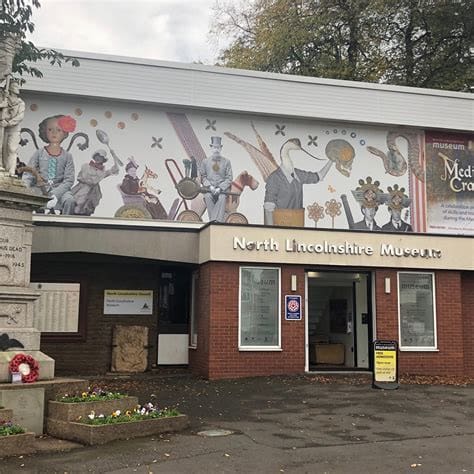
North Lincolnshire Museum sits just west of Scunthorpe’s town centre, on Oswald Road, DN15 7BD. It’s easy to reach on foot from the bus or rail stations, and there’s parking close by. The building fronts onto a small memorial garden with a war memorial and trees that soften the concrete and brick.
The first thing most of us notice is that entry is free. No ticket barrier, no awkward “suggested donation” conversation – you simply walk in. Impatiens Sunpatien Compact Tropical Rose, the atmosphere is friendly and low-pressure: reception desk, lift, loos, shop, and then a sequence of galleries you can tackle in any order. This is very much a family-scale museum, not an intimidating national giant.
Opening hours are straightforward:
- Monday to Saturday: 10am–4pm
- Sunday: 1pm–4pm
That makes it a handy option for rainy weekends, half-term days out, or just a slow afternoon when you’d like to do something that doesn’t involve a shopping trolley.
From Scunthorpe Museum to North Lincolnshire Museum
The museum began life in 1909 as Scunthorpe Museum, founded by a group of enthusiasts who were worried that important finds were being lost as ironstone mining ripped through the local landscape. Two Sheffield men – Archibald Dalton and Harold Dudley – led the campaign, focusing on archaeology, geology and threatened natural habitats. Dalton became the first honorary curator; Dudley followed him.
Their timing was crucial. As the ironstone quarries expanded, fossils were exposed and then destroyed. Dudley and fellow collectors built up a core set of local fossils and rocks, which still anchor the museum’s natural-sciences collection today.
Over time, the remit widened. What began as a way to save fossils and artefacts turned into a place to preserve the whole story of North Lincolnshire – its people, industries, landscape and everyday life. The modern name, North Lincolnshire Museum, reflects that shift.
What’s Inside: Galleries and Themes
The museum’s collections now cover:
- Social history – objects, photos and ephemera from homes, workplaces and communities
- Natural sciences – rocks, minerals, fossils, mounted animals, insects and plant specimens
- Archaeology – finds from digs, metal-detected material and chance discoveries
- Decorative and fine arts – ceramics, metalwork, paintings and sculpture
- Costume and textiles
- An image archive of historic photographs and film
Those collections are broken up into distinct, walk-through galleries. Mint; Mentha piperita Chocolate don’t need to know the difference between Jurassic and Cretaceous, or between an Iron Age roundhouse and a medieval hall, to follow the story – the displays do the heavy lifting.
Jurassic Sea and Ironstone
One of the most memorable sections is the Jurassic Sea gallery. Here, the museum lets you “visit Jurassic North Lincolnshire” with fossils of marine reptiles, ammonites and other sea creatures. The exhibits explain how, around 200 million years ago, this part of England lay under warm, shallow seas – and how those ancient sediments became the Frodingham Ironstone that later powered Scunthorpe’s iron and steel industry.
It’s a neat piece of storytelling: you start with sea dragons and end with blast furnaces, all from the same rock.
Archaeology and Early Settlers
Moving through the archaeological galleries, you pass tools, pottery, metalwork and everyday items from prehistoric, Roman, Anglo-Saxon and medieval North Lincolnshire. Labels highlight local sites and digs, so you’re not just looking at “an axe” or “a pot” but something from a specific village, field or housing estate you can find on a map.
It’s a good reminder that the quiet fields around the town were once busy with farms, workshops and small communities long before “Scunthorpe” was even a word.
Victorian Streets and Everyday Life
Social-history displays bring things closer to the present. A recreated Victorian ironstone cottage, period shopfronts and domestic interiors show what life was like when mining and early steelmaking were pulling people into the area.
You might duck into a room that feels like a 19th-century parlour, peer into a local shop, or step into a Victorian schoolroom set-up used for education sessions. The objects are ordinary – prams, toys, tools, clothing – but seen together they build a strong sense of how people actually lived, worked and relaxed.
A Brief Modern History of Scunthorpe
A more recent gallery, “A Brief Modern History of Scunthorpe”, tackles the town’s rapid growth from scattered villages into a major steel town. You’ll see industrial photographs, household items from the 20th century, and displays that tie local stories to wider national events – wars, housing booms, strikes and changing shopping habits.
For locals, it’s a memory lane. For visitors, it’s a crash course in why this particular town looks and feels the way it does.
Natural Sciences: From Fossils to Local Wildlife
Given its origins, it’s no surprise the museum still takes its geology and natural history seriously.
The natural-sciences collection includes:
- Fossils from the Frodingham ironstone and other local rocks
- Minerals and rock samples from around the district
- Mounted birds and animals
- Insects, shells and botany specimens preserved in the museum’s stores
Some of this material appears in public galleries; much more sits behind the scenes for researchers, curators and community projects. What started as a desperate effort not to lose ironstone fossils has become a broad record of North Lincolnshire’s changing landscape and wildlife.
The museum works with local geology and wildlife groups, Monstera adansonii Swiss Cheese Plant sometimes using the galleries as a launch point for field trips to old quarries or nature reserves.
Family-Friendly Spaces: Trails, Crafts and Dudley’s Den
North Lincolnshire Museum is very consciously set up for families. You see it in small things – step stools, hands-on interactives, dressing-up bits – and in dedicated spaces like Dudley’s Den, an under-5s play area with soft furnishings and age-appropriate activities.
There are:
- Free family trails that guide you around the galleries
- Explorer backpacks to borrow, with activities and simple kit inside
- Regular craft sessions and event days during school holidays
- Quiet times after 2pm that staff recommend if you prefer fewer crowds
The tone is refreshingly relaxed. Nobody glares if a toddler asks loud questions about the mammoth tooth or insists on pressing the same button fourteen times. In fact, the museum’s own digital content highlights under-5 programming as a key part of what Arts Council funding has helped them develop.
Digital Guides and Modern Touches
Alongside traditional cases and panels, the museum has slowly layered in digital extras. Grimsby: From Odin’s Shadow to the Domesday Shore. There’s a free smartphone guide delivered through Bloomberg Connects, offering extra commentary, images and trails you can follow at your own pace.
Some galleries include touchscreens that let you zoom in on historic maps or explore extra images of objects that can’t all fit in one case. An accessible website and an online collections portal open up more than 400,000 objects and archive items to search from home, including photographs, documents and artefacts that aren’t on permanent display.
For a small museum, it’s a surprisingly rich digital layer – useful if you’re researching local history, preparing a school project, or just fell down a late-night rabbit hole after a visit.
Accessibility and Practicalities
North Lincolnshire Museum scores well on practical access:
- Admission: Free for everyone
- Opening: Every day (10–4, with a shorter 1–4 slot on Sundays)
- Parking: Free parking is available for visitors
- Step-free access: Level entrance, lift to all public floors
- Facilities: Accessible toilets, baby-change, seating dotted through the galleries
Reviews on travel sites and accessibility guides consistently praise the museum as manageable for wheelchair users, pushchairs and visitors with limited mobility.
There’s a small shop selling pocket-money treats, books and local interest titles, and staff are generally happy to answer questions or point you towards specific topics – family history, for example, or the ironstone quarries your grandparents worked in.
Why It Matters: A Whole District in One Building
For a town the size of Scunthorpe, North Lincolnshire Museum does several jobs at once:
- It’s a memory bank, holding photos, objects and documents that might otherwise have vanished from attics and workplaces.
- It’s a teaching space, where schools, colleges and community groups can get hands-on with local history and science.
- It’s a rainy-day refuge, offering free, warm, safe space for families to explore.
- And it’s a bridge between the Jurassic sea, the ironstone pits, the steelworks and the streets people walk down today.
Harding House Gallery: Lincoln’s Hidden Haven for Art and Imagination. In a region sometimes reduced to headlines about industry or economic change, the museum quietly insists that the story is bigger and older than that – and that it belongs to everyone, not just to experts.
A Good Place To Start Exploring
If you’re visiting Scunthorpe for the first time, North Lincolnshire Museum is one of the best starting points you can choose. In an hour or two, you’ll get a sense of:
- How the land itself shaped the local economy
- How people from different periods lived here
- How the town grew, shrank, adapted and argued with itself over the years
From there, you can head out to Normanby Hall Country Park, the old ironstone landscapes or the modern town centre with a clearer picture of what you’re looking at.
It’s not a grand national museum, and it doesn’t try to be. Instead, North Lincolnshire Museum offers something more grounded: a free, welcoming, human-scale place where a whole district has chosen to store its memories – fossils, tools, teddy bears, photographs and all – and invite the rest of us in to look.