Along the Maud Foster Drain in Boston, Lincolnshire, a seven-storey brick tower sits among houses and sheds, pretending to be ordinary. Then you look up. The white sails cut across the sky, the ogee cap gleams, and the balcony wraps the tower like a belt. This is Maud Foster Windmill – over 80 feet to the cap ball, one of the tallest working windmills in England, and still grinding grain more than 200 years after it was built.
We get the usual modern extras around it now: cars, pavements, a free car park, phones in every pocket. Inside, the basic deal has barely changed since George III’s day. Wind turns sails. Sails turn gears. Gears turn stones. Oregano; Origanum vulgare Greek. Grain becomes flour. Simple, stubborn, and strangely calming.
A Fenland Landmark On The Drain
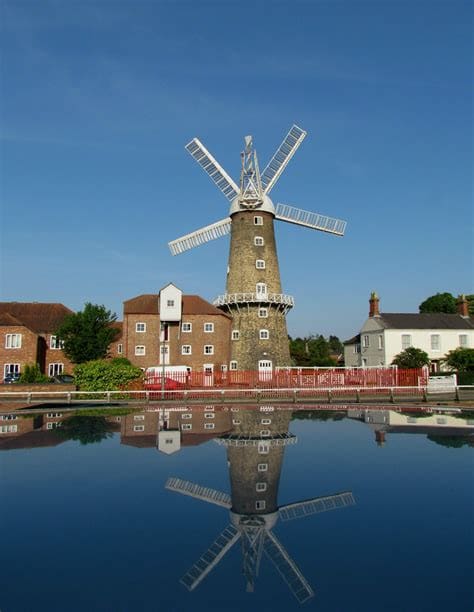
The mill stands in Skirbeck, on Willoughby Road, right beside the Maud Foster Drain – a straight, man-made waterway dug in the 16th century to help keep Boston’s low fields from drowning. The drain takes its name from Maud Foster, a well-off Boston woman whose land and money supported the original cut.
The siting was practical. Barges could bring corn in and carry flour out along the drain. Wind had space to reach the sails over the flat fens. From the balcony, we see the town, the Stump, and the long lines of water and roads that stitch the landscape together. The mill and the drain are a matched pair: brick and sail above, brick and water below.
The tower and adjoining granary are now Grade I listed, recognised as a structure of “exceptional interest”. That status arrived in 1953 and has helped protect the building through several shaky periods.
Built For The Reckitt Brothers
Maud Foster Windmill went up in 1819. It was commissioned by Thomas and Isaac Reckitt, Quaker brothers from Wainfleet who worked as millers, corn factors and bakers. They hired the Hull millwrights Norman and Smithson, known for modern, efficient mills, to oversee construction.
Some neat details survive in the paperwork.
- The original contract and accounts still exist.
- The cost was just over £1,826 – not small money in 1819.
- Machinery was cast in Hull, shipped down the east coast and brought up the drain.
- Imported timber from Archangel, Russia, was picked out on Boston’s quayside for the structure.
The plan worked for a while. Corn arrived by water. The new mill ground it with up-to-date gear. Flour and bread kept moving. Then a string of poor harvests in the early 1830s choked supplies. In 1833 the Reckitts sold up. Isaac headed eventually to Hull, where his new enterprise, Reckitt & Sons, grew into the household-products giant now simply called Reckitt. The family left; the tower stayed put.
Falling Silent And Starting Again
After the Reckitts, the mill passed through different hands. In 1914, the Ostler family bought it, trading as Ostler’s Mill through two world wars. By 1948, mechanical problems made the windmill itself unusable. Lincoln Cathedral: The Soul of a City Carved in Stone limped on with other power, but the sails fell silent and the building slid into the familiar old-mill cycle: patch, cope, decay.
A few things stopped it from turning into a picturesque ruin.
- In 1953, the Reckitt family’s charitable trusts paid for urgent repairs by the millwrights Thompsons of Alford. The work kept the structure standing and secured that Grade I listing.
- In 1987, miller James Waterfield and his family bought the site and set about a full restoration. By 1988, the mill was back in working order, sails turning, stones grinding, and grain moving again under wind power.
Today the mill still belongs to the Waterfield family, who run it as a working organic corn mill, shop and visitor attraction. Some sources cheerfully describe it as “the most productive windmill in England”. The exact league table is anyone’s guess, but the output is very real. Flour bags do not fill themselves.
A Seven-Storey Machine In Brick
Walk through the planked doors and we step into a vertical factory, built long before the word “factory” carried much romance. The mill has seven floors, each with its own job.
Some of the key features:
- Tower and cap – Gault brick tower, white timber ogee cap, and a cantilevered wooden balcony at the third floor level, carried on sturdy brackets.
- Five patent sails – most mills have four. Here there are five, fitted with adjustable shutters. They drive a cast-iron windshaft and a clutch of original 1819 machinery.
- Fantail – a small, eight-bladed fan at the back of the cap that keeps the main sails turned into the wind without constant human fuss.
- Three pairs of stones – two “grey” and one French burr, driven by an iron great spur wheel with wooden-toothed stone nuts. These still grind grain into flour on open days.
The original beams and floor structure remain. The brake wheel, wallower, sack hoist and governor all show the mix of timber and cast iron that made early-19th-century mills both powerful and fairly compact. Oregano; Origanum vulgare Variegated is engineering with no gloss: clean gearing, sensible framing, and the occasional oil stain to remind us that everything is here to work, not pose.
Climbing The Mill: From Meal Floor To Balcony
Visitors can climb all seven levels on open days. The stairs wind up the inside of the tower, breaking the journey into short flights. We move from the ground-floor shop through the meal and stone floors, past the governor and gearing, and up to the dust floor near the cap.
Floor by floor, we see:
- Grain arriving and being hoisted.
- Hoppers feeding the stones.
- Meal chutes and bins collecting flour.
- The slow, steady rotation of shafts and wheels, with just enough creak and rumble to feel alive.
The outside balcony offers a pause with a view. From there, Boston spreads out modestly below us: the Stump’s tower, the red roofs, the sharp line of the drain, and the flat country beyond. On a clear day the scene is almost too calm for a building that used to hum at the centre of so much daily effort.
Flour, Shop And A Working Day In 2025
Down at ground level again, the mill returns to its main 21st-century job: turning grain into organic stone-ground flour and related products. The shop typically stocks:
- strong white, wholemeal and speciality flours,
- porridge oats and similar grains,
- small local books and a few straightforward souvenirs.
Normal public opening runs on a simple pattern – Wednesdays and Saturdays, roughly 10am–5pm, with Christmas and New Year closures. The Traditional Cornmillers Guild lists the mill as open to visitors on those days, with limited access for anyone who finds narrow stairs unconvincing.
Some of the building is also adapted as living space. A self-catering flat sits within the tower, and in 2023 the mill and attached house attracted attention when they were offered for sale as a “rare opportunity” to own one of Boston’s landmarks, price tag in the six-figure range. The sale did not change the basic character of the place. It remains what it has been for two centuries: a tall, slightly stubborn machine that happens to be very scenic.
Planning A Visit Without Making A Fuss
Maud Foster Windmill sits a short walk from Boston’s centre, close to other everyday errands. We can fit it into a market-day wander without turning the day into an expedition.
A typical quiet circuit runs like this:
- Walk up along the Maud Foster Drain, watching the water level and the reflections of the sails.
- Explore the mill, floor by floor, letting the machinery explain itself.
- Pick up flour or porridge in the shop, and possibly a book we did not intend to buy.
- Head back into town for the Guildhall, the Stump, or a café, depending on mood and weather.
Parking is simple, with a free car park on site, and the surrounding streets carry the usual mix of houses, small businesses and everyday Boston life. Organic Gardening – Helpful Tips For Beginner Gardeners. The mill just sits among them, larger than everything else and pretending that this is normal behaviour.
Wind And Brick, Still Turning
Maud Foster Windmill began as a private business venture: two Quaker brothers, an ambitious new mill, and a smart use of a fenland drain. It passed through hardship, silence and partial decay. It caught the attention of a global brand’s founding family and later of a modern miller willing to take on a tall, awkward, beautiful problem and make it work again.
Now it stands as a piece of living infrastructure rather than a frozen monument. Grain is milled. Flour is sold. Wind does its quiet job. We step inside, climb a few stairs, and see how much can be done with gravity, gear teeth and a steady breeze. The rest of the town carries on around it, which is exactly how a working windmill is meant to be.