Boston in Lincolnshire is one of those English towns that looks modest on a map and then turns out to have fingerprints all over world history. It’s a flat-land market town with a big church, a busy river and fields of vegetables stretching out to the horizon – and it also lent its name to Boston, Massachusetts and played a part in the story of the Pilgrim Fathers.
Let’s take a walk through the town, from the top of the Stump down to the marsh edge.
Setting the Scene: A Town in the Fens
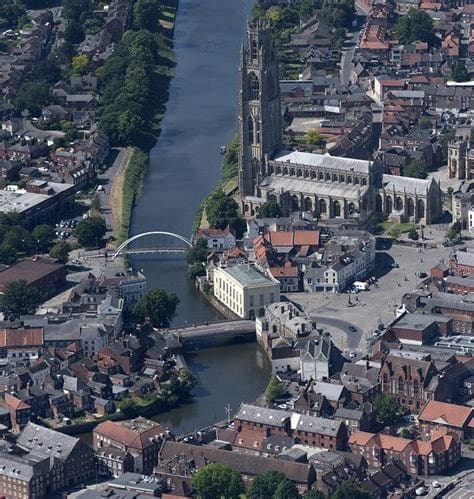
Boston sits in south-east Lincolnshire, on the River Witham where it becomes The Haven, about five miles from The Wash. Lincoln lies to the north-west, Nottingham to the west, and Peterborough down to the south-west. That puts Boston right in the low, open landscape we call the Fens – big skies, straight drains, and very little in the way of hills.
The town itself had 45,339 people at the 2021 Census, and the wider district is now over 70,000 after strong growth in the last decade. Many of those new residents have come from overseas, particularly from Eastern Europe. In recent figures, around 5–6% of local people were born in Lithuania and a similar share in Poland, and Polish is the main language for roughly one in twenty residents.
So when we walk through town, we hear a mix of English, Polish, Lithuanian and other languages blending in with Lincolnshire accents. It’s still a classic market town, but with a very international flavour Pansy Cool Wave White.
The Stump: Boston’s Tower on the Fens
You can’t really talk about Boston without talking about St Botolph’s Church, better known as “The Stump”. The church dominates the skyline, its great tower rising up out of the flat fenland like a stone lighthouse.
- The tower is about 266–272 feet high, making it one of the tallest parish church towers in England.
- On a clear day, you can see it from across The Wash in Norfolk – it was a crucial landmark for sailors and travellers crossing the Fens.
Inside, the church is huge and light, with tall windows and a long nave. Modern interpretation sits alongside medieval stonework:
- A Tower Experience lets you climb more than 200 steps for big-sky views over the town, river and fields.
- Digital screens, family trails, and even a Lego model of the Stump make it feel welcoming rather than hushed and forbidding.
We can grab a drink in The Refectory café tucked under the tower, then wander round reading about Boston’s role in the story of the Puritans and the Pilgrim Fathers, who eventually helped found Boston, USA.
From the top of the tower, the town makes sense: red roofs, the line of the Witham, the docks, and then the green and brown patchwork of fenland farms pushing right out to the faint line of The Wash.
From Medieval Port to Food-Growing Powerhouse
If we step back a few centuries, Boston was once one of England’s most important medieval ports. In the 13th and 14th centuries, trade across the North Sea with the Low Countries made the town wealthy; for a time its customs revenues rivalled even London’s.
That prosperity paid for the Stump and for fine buildings like the Guildhall, where merchants and local leaders met. Today, Boston Guildhall is a museum and heritage site, with timber beams, panelled rooms and stories about trade, religion and politics.
Over the centuries, the Fens around Boston were drained and reshaped into some of the most productive farmland in the country. Now the area is famous for:
- Vegetables and salad crops
- Flower and bulb growing
- Food processing, packing and logistics
Walk round the outskirts and you’ll pass packhouses, refrigerated lorries and fields of cabbages, potatoes and brassicas. The port is still active too, moving grain, timber, steel and other bulk cargoes along the Haven and out into The Wash.
In other words, Boston is a place where your supermarket veg and your bulk imports quietly slip in and out while most of us are thinking about something else.
A Market Town With Layers
At street level, Boston feels like many English market towns – and then not quite like them at all.
Market Place and Everyday Life
The Market Place spreads out by the Stump, with regular outdoor markets bringing stalls of fruit, veg, clothing, tools and household bits and pieces. On a market day, you hear stallholders calling, church bells above, and a blend of languages in the crowd.
Around the square and along the surrounding streets, there’s a mix of:
- Independent shops and international supermarkets
- Cafés and bakeries with both British and Eastern European bakes
- Traditional pubs, charity shops and takeaways
It’s not polished and curated in a tourist-board way. It’s a working town centre where people shop, queue at banks, pop into barbers, Peperomia asperula and sit on benches with a bag of chips.
Old Streets and Waterside Corners
If we explore a bit further, we find narrower streets like Wormgate, with independent businesses, and older buildings tucked between more modern frontages. The Witham and the Haven provide some surprisingly atmospheric corners – moored boats, brick warehouses, bridges and the odd glimpse of open water between buildings.
A little way along the Maud Foster Drain stands the striking Maud Foster Windmill, a tall brick tower mill dating from 1819. It’s one of the tallest working windmills in the UK, and on open days you can climb inside to see the machinery and buy stone-ground flour.
All of this gives Boston a layered feel: medieval port, Georgian and Victorian civic pride, 20th-century industry and 21st-century migration all living in the same street plan.
Nature on the Edge: Marshes, Woods and Big Skies
One of Boston’s quiet strengths is how quickly we can swap pavements for wide, open landscapes.
Frampton Marsh and Freiston Shore
A short drive from town takes us to RSPB Frampton Marsh and Freiston Shore, internationally important wetlands on the edge of The Wash. Here we get:
- Waders and wildfowl in huge numbers at the right times of year
- Reedbeds, saltmarsh and lagoons under huge skies
- Hides and trails that work for both keen birders and casual walkers
On a still evening, with flocks of knot or lapwing twisting over the water and the Stump just visible on the horizon, it’s easy to see why this coast matters, both for wildlife and for people who need a breather.
Boston Woods
To the west of town, the Boston Woods Trust has been steadily creating new woodland and meadow. Paths weave through plantations of young trees, older copses and open grass, offering a softer alternative to the flat fields.
These woods are still maturing, but they already give us somewhere shady to walk dogs, stretch our legs and hear birdsong instead of traffic.
People, Change and the Brexit Headlines
Boston’s rapid population change has attracted a lot of attention in recent years. The district saw a 9.1% population rise between 2011 and 2021, driven heavily by migration from EU countries, especially in response to demand for agricultural and food-processing labour.
In the 2016 EU referendum, Boston recorded the highest “Leave” vote share in the UK, at around 76%. That result turned the town into a kind of shorthand in political commentary – “Brexitland”, a place discussed in think-tank reports and TV documentaries.
On the ground, life is more complicated and more ordinary than any label. We see:
- Long hours in fields, packhouses and factories
- High demand for housing and local services
- New shops, churches and community groups alongside long-standing ones
For those of us visiting or passing through, it’s worth remembering that this is not just a “case study town”. It’s a place where people are simply trying to make a living, raise families and get on with things, in a landscape that has always been shaped by movement – of water, of goods, Pepper Carolina Reaper and now of people.
Things We Can Do in a Day (or Two)
If we’re planning a visit, Boston rewards a gentle pace rather than a checklist rush. A simple plan might look like this:
1. Start in the Market Place and the Stump
- Wander the stalls on a market day.
- Step inside St Botolph’s, explore the nave and chapels, and if we’re feeling energetic, climb the tower for those fenland views.
2. Explore the Guildhall and Old Streets
- Head to Boston Guildhall to see where merchants, magistrates and later prisoners spent their days.
- Drift along Wormgate and surrounding lanes, dipping into small shops and cafés – maybe trying both a traditional British bakery and an Eastern European deli in the same afternoon.
3. Walk to Maud Foster Windmill
- Follow the Maud Foster Drain to the windmill, photograph it against the sky and, if it’s open, climb up inside to feel the whole tower hum when the sails are turning.
4. Finish Out on the Marsh
- Take a short trip out to Frampton Marsh or Freiston Shore for a complete change of mood: wide horizons, birds, seawalls and the soft rush of wind over saltmarsh.
With that mix, we touch medieval wealth, Reformation drama, migration stories, modern politics and quiet wildlife all in one small corner of Lincolnshire.
Fenland Town, Far-Reaching Stories
Boston, Lincolnshire, is not a polished theme-park version of history. It’s a working market town and inland port where the big church still rings the hours, the river still earns its keep, and the fields around town feed a lot of dinner tables far beyond the Fens.
As we stand in the Market Place, with the Stump towering over us, we’re connected to a trading port that once rivalled London, to Puritans who sailed westward and left a namesake city on another continent, and to modern arrivals who’ve crossed borders to work the same soils and pack the same vegetables.
If we give ourselves time here – to climb the tower, sit by the river, walk the marsh edge and listen in on everyday conversations – Petroselinum crispum Parsley Flat Italian we start to see Boston as more than a line in a referendum chart or a footnote in American history. It becomes what it has always been: a fenland town with long horizons, deep roots, and stories that travel a very long way from the flat land around it.