Boston Guildhall sits on South Street, a short walk from the river and the Stump. From the pavement it looks like a neat slice of late-medieval Boston wrapped in some tidy later brickwork. Inside, it turns out to be a quiet overachiever: merchant HQ, religious powerhouse, courtroom, jail, museum, wedding venue, and a footnote in the story of the Mayflower, all in one compact building.
It is easy to stroll past and mistake it for a pleasant old hall with some nicely painted arms. The history has other Opuntia microdasys Bunny Ears.
A Merchant Guild With Big Ambitions
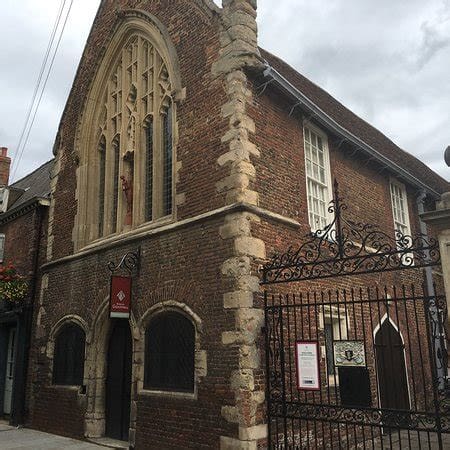
The story starts in the thirteenth and fourteenth centuries, when Boston’s trade with the Low Countries was booming. Local merchants formed St Mary’s Guild in 1260, a powerful religious and commercial fraternity. Around 1390, the guild built itself a new hall on South Street. Dendrochronology on the roof timbers politely confirms the date.
The guild did very well. It collected gifts of land, gold and silver. It acquired relics. It specialised in selling indulgences – payments for prayers and masses to ease souls through the afterlife. That trade made the guild one of the richest in England and helped pay for the hall’s generous proportions.
The building carried that mixture of piety and profit in its fabric.
- A lofty great hall for feasts, meetings and devotions.
- Service areas below, where food was prepared and business conducted.
- A strong street presence that said, very politely, that this was where power sat in town.
From the start, Boston Guildhall was not shy about its place in local life.
Crown Confiscation and Civic Takeover
The indulgence business did not age gracefully. By the mid–16th century, Protestant reformers were less enthusiastic about money changing hands for salvation. Under Edward VI, religious guilds and chantries were dissolved. St Mary’s Guild lost its assets. In 1555, the Guildhall passed to the Boston Corporation, the town’s civic authority.
The building moved from sacred-commercial hybrid to town hall with attitude.
Over the next two centuries, the corporation adapted the interior for:
- council meetings and mayoral business,
- civic feasts,
- law courts,
- ground-floor gaol cells for local offenders.
By the 18th century, Boston wanted something more in keeping with Georgian taste. A smart brick frontage with sash windows and a classical doorcase arrived, masking some of the medieval fabric. The shell stayed; the face changed.
The result today is an odd but handsome mix: medieval structure, Georgian polish, Lincoln Cathedral & Steep Hill Stairs and a basement that tells a more cramped story.
The 1607 Pilgrim Episode
The Guildhall’s most quoted moment came in 1607, before the Georgian spruce-up, when it served as both courtroom and jail for a group of religious dissenters now known as the Pilgrim Fathers.
That autumn, a Separatist congregation from the Scrooby and Gainsborough area tried to flee to the Dutch Republic. They had arranged for a Dutch captain to meet them at Scotia Creek, Fishtoft, on the Haven below Boston. The captain instead alerted the authorities. The group was arrested on the marsh and brought by boat to the town.
In the Guildhall:
- Magistrates sat in the council chamber and heard the case.
- Men, women and children stood accused of trying to leave the realm without royal permission.
- Some were held in the cells under the hall for about a month.
A plaque above the cell doors now records that William Bradford and William Brewster, later leaders of the Mayflower group, were among the prisoners “after attempting to escape to religious freedom” on 23 September 1607.
The magistrates eventually discharged most of them. The congregation regrouped, reached Holland by another route, and in 1620 a portion sailed on the Mayflower to found Plymouth Colony. The Boston episode became an early chapter in that longer story.
For the Guildhall, it was one more day’s work in a busy calendar. Court upstairs, prisoners downstairs, paperwork somewhere in between.
Georgian Facades and Everyday Authority
By the 1700s and 1800s, Boston Guildhall had settled into its civic role. Wealthy merchants and aldermen still used the upper hall for dinners and meetings. Justices dispensed local justice. The Royal Arms and civic portraits watched from the walls.
The new Georgian frontage gave the building a thoroughly respectable face.
- Symmetrical windows.
- Brick pilasters and railings.
- A gate and forecourt that separated official business from the street by a polite few feet of paving.
Behind that façade, the medieval timber roof and hall survived beneath later plaster and paint. The structure carried on doing what it had always done: providing shelter for whatever the town’s ruling group currently thought important.
As municipal functions moved to more modern premises in the 20th century, the Guildhall slid out of daily administrative use. Makers Millers & Miles survival into the 21st century as a single, coherent complex counts as a small miracle of inertia and good timing.
Museum Rooms and Pilgrim Cells
Today Boston Guildhall works as a free town museum and heritage site, managed by the local council. It carries Grade I listed status and a quiet sense of having earned it.
The building is open, under normal circumstances:
- Wednesday to Saturday
- 10.30am–3.30pm, last admission at 3pm
Entry is free, though the staff are unlikely to object if a donation appears. The hall also hosts weddings and private hire, so occasional changes to hours are part of the package.
Inside, the museum uses the historic rooms to tell several strands of Boston’s past:
- The merchant guild period, with displays on medieval trade and the North Sea wool connection.
- The corporation years, including civic silver, portraits and court paraphernalia.
- The Pilgrim Fathers story, with interpretation on the 1607 arrests, original documents on loan from the archives, and the preserved cells.
Visitors move through the kitchens and service areas, with their brick floors and low arches, up into panelled chambers and the long upper hall. In one room, an original copy of Foxe’s “Book of Martyrs” sits behind glass, a reminder of how strongly religious conflict once shaped this town’s life.
The cells remain the most arresting (and least spacious) part of the tour. White-painted walls, heavy doors, iron grilles and that small inscription about Bradford and Brewster combine to cut through any romantic haze. This was not a comfortable stay. It was a holding area for people who had irritated the authorities.
Banqueting Hall, Weddings and Community Use
The great hall upstairs, once a place for guild feasts and civic dinners, now divides its time between museum space and ceremonies. The timber roof, large traceried window and painted arms form a striking backdrop for modern weddings and civil partnerships.
Lincolnshire’s registration service promotes Boston Guildhall as a historic venue:
- Grade I status for those who like their vows with a side of heritage.
- A bright, panelled interior that needs very little extra decoration.
- A sense that the building has seen far more dramatic oaths than anything most couples are likely to attempt.
Beyond ceremonies, the hall hosts talks, small concerts, school visits and community events. The museum, the Visitor Information Centre, and local heritage groups all make use of the space.
The building therefore continues to behave like a civic hub, just with fewer wigs and rather more risk assessments.
Planning A Visit Without Fuss
Boston Guildhall fits neatly into a wider wander around town. A simple route works well.
We move through the Market Place, look up at St Botolph’s, and then drift down to South Street. The Guildhall sits just beyond the bridge over the Witham, its brick front and wrought-iron gate set slightly back from the pavement.
Inside, the visit usually runs along these lines:
- Ground floor: reception, small shop, access to the kitchen range and the cells.
- Upper floor: council chamber, banquet hall, exhibitions on trade, religion and migration.
- Occasional extras: temporary displays, events linked to Pilgrim anniversaries or local themes.
The scale is human. This is not an all-day national museum. An hour or two is enough to see the building, read the interpretation and let the strands of history line up in your head. After that, the river, the Stump, and Maud Foster Windmill are all close enough for the next Opuntia rufida minima monstrose Cinnamon Cactus.
Fenland Hall With Far Horizons
Boston Guildhall is not a vast palace or a battle-scarred fortress. It is a merchant hall that grew into a town hall, quietly watched some of the Pilgrim Fathers pass through its cells, and then slid into semi-retirement as a museum and events venue.
The building’s interest lies in that mixture.
- Medieval wealth from the wool and indulgence trade.
- Early modern tension between church, crown and conscience.
- Georgian ambitions for order and respectability.
- Modern efforts to keep the whole thing standing, open and in use.
We walk its brick floors, duck under its beams and read the neat panels about people whose choices had wider consequences than they knew. The hall remains in the same place on South Street. Its stories have long since crossed the North Sea and the Atlantic.