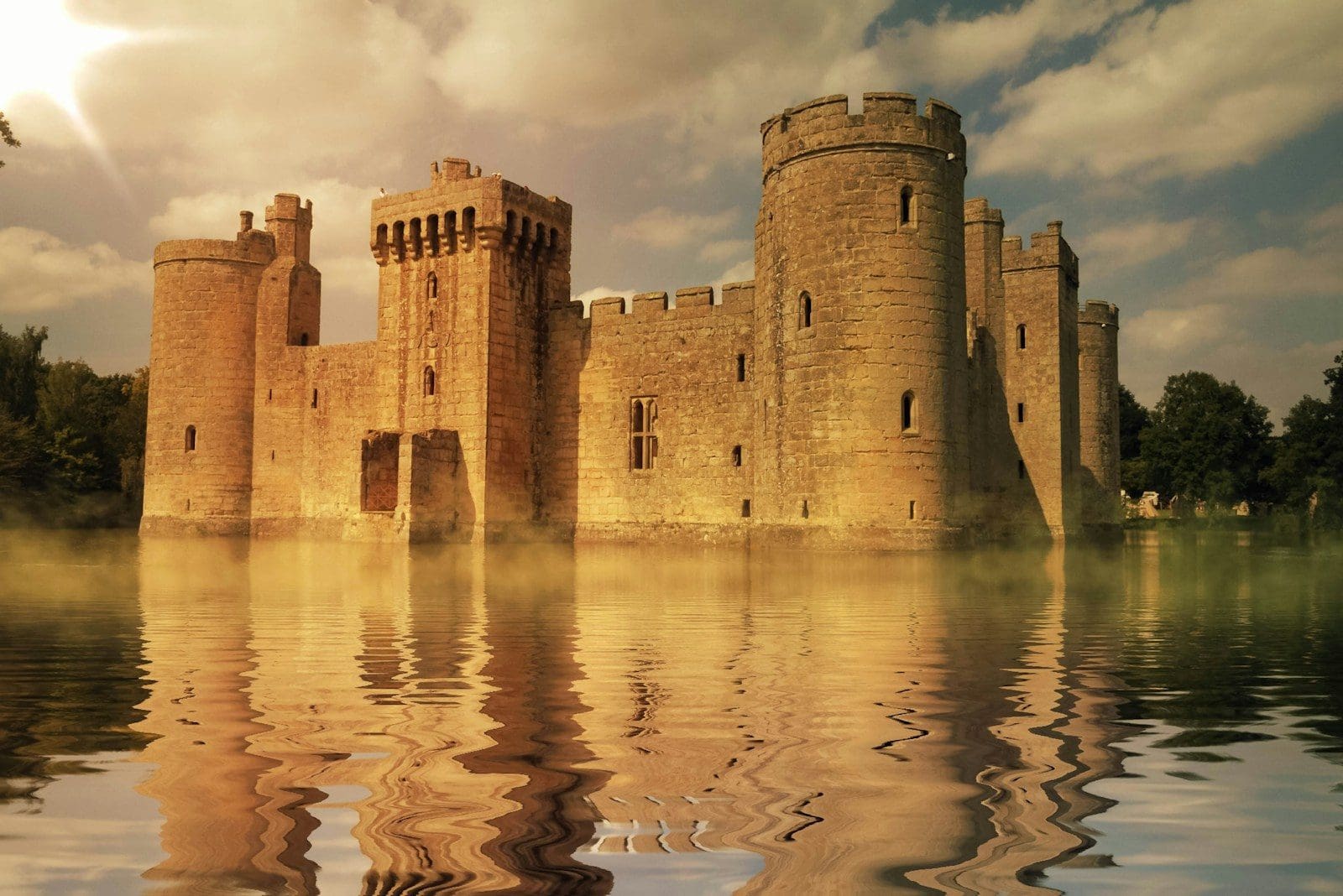
Sleaford Castle is one of those places that asks very little of us at first.
There is no grand tower. No gift shop selling wooden swords. No dramatic drawbridge where someone can stand with a latte and feel medieval for twelve minutes.
Instead, we get a quiet green space near the River Slea. A few earthworks. A small piece of masonry. Some signs. A field that looks, to the hurried eye, like a place for dogs, children, and a short pause before tea.
But that is the trick.
Sleaford Castle was once one of the most important power sites in the town. It was built by Alexander de Blois, Bishop of Lincoln, between 1123 and 1139, and it stayed in church hands for more than 400 years. It later fell out of use, was partly demolished, and left us with the puzzle we see today. A castle, but mostly underground. Very Lincolnshire. Even the drama is modest.
A Castle Built by a Bishop, Not a Baron
Most of us picture castles as the work of kings, warlords, or ambitious nobles with poor impulse control.
Sleaford Castle was different.
It was built by a bishop. That sounds gentle, until we remember that medieval bishops were not just churchmen. They were landowners, judges, administrators, political players, and, when needed, men with serious walls.
Alexander de Blois was Bishop of Lincoln in the early 12th century. He also built castles at Newark and Banbury. Sleaford was part of that same pattern. It was not a random pile of stone dropped into the fen edge. It was a statement.
The message was simple enough: the Bishop of Lincoln had power here.
And yes, apparently a bishop could preach peace while also building a stronghold. Medieval life was wonderfully consistent like that.
Why Sleaford Needed a Castle
Sleaford’s location mattered. The origins of Sleaford are tied to the same mix of water, farmland and useful routes.
The town sat near farmland, water, and routes that helped goods move. The River Slea shaped local life. So did the wider fen landscape. This was not empty land. It was productive land.
That made it worth controlling.
Historic England describes Sleaford Castle as an enclosure castle. In plain English, that means its main defence came from walls, towers, ditches, and water. It was not a classic motte-and-bailey mound with a timber tower on top. It was more about stone, layout, and managed space. The site had an inner bailey, an outer bailey, moats, domestic buildings, and estate buildings.
In other words, this was not only a fighting place.
It was an office. A storehouse. A residence. A food centre. A place where rents, crops, rights, and authority met. Which is less romantic than a siege, but much closer to how power often worked.
Power is not always a sword.
Sometimes it is a barn full of grain.
The Castle as a Working Estate
One of the most useful ways to understand Sleaford Castle is to stop thinking of it as only a military building.
Yes, it had defences. Yes, it had walls and water. But its long life was tied to the bishop’s estates. It helped manage land and produce. It held goods. It supported the business of the manor.
Historic England notes the remains of a large manorial barn in the outer bailey. Documentary sources from the 14th to 16th centuries record produce from the bishop’s estates being stored there. There were also remains linked with a dovecote, byre, constable’s hall, stables, and other working buildings.
That tells us something important.
The castle was part of Sleaford’s daily economy. It was not just a stone threat on the edge of town. It was tied to farming, food, records, animals, servants, officials, and all the ordinary things that keep a great estate going.
If we want to picture it properly, we should add noise.
Hooves. Carts. Doors. Men calling across the yard. Grain being moved. Water running in the moats. A clerk trying to look important. Someone, somewhere, complaining about the weather.
So, yes. Very familiar.
Kings Came Through Sleaford Too
Sleaford Castle did not sit outside national history. It had moments when wider events passed through its gate.
The Lincolnshire Historic Environment Record says the castle was surrendered to King Stephen in 1139, then later returned to the Bishop of Lincoln. It also records that King John visited on 14 October 1216. Henry VIII may also have stayed at the castle during visits to Sleaford in 1541.
King John’s visit is especially striking.
In October 1216, John was near the end of his life. His reign was in crisis. The story of his lost baggage in the Wash has become one of those English history tales that refuses to go away. Shortly after, he died at Newark.
So when we say Sleaford Castle was visited by King John, we are not adding a cute royal footnote.
We are placing Sleaford inside a tense national moment.
The same applies to Henry VIII. By 1541, the Tudor world was changing fast. Monasteries had been dissolved. Church property was being reshaped. Old religious power was being broken up, traded, or absorbed by the Crown and its favourites.
Sleaford Castle stood right in the path of that change.
Decline, Dismantling, and the Usual Recycling Scheme
The castle’s decline came in the 16th century.
By then, England had changed. The medieval bishop’s stronghold no longer had the same role. In 1547, Sleaford Castle was transferred by Bishop Holbeach to Edward, Duke of Somerset. After that, it became a source of building material. Historic England says it was progressively dismantled, although parts of the walls and towers were still standing in 1720. Today, the only masonry fragment visible above ground is part of the north-eastern corner tower.
This is a very English end for a castle.
Not blown up in some grand last stand.
Not stormed by heroic troops.
Just slowly taken apart because stone was useful.
The past became a quarry. The walls became someone else’s wall. The castle slipped into the town in pieces. Quite literally.
It is a little sad. It is also practical. And practicality has always had a strong vote in Lincolnshire.
What You Can Still See Today
Today, Sleaford Castle is a scheduled monument. That means it is legally protected because of its national importance. Historic England first listed it on the schedule in 1949, with a later amendment in 1995.
The site is now mostly earthworks and buried remains.
That may sound disappointing if we arrive expecting battlements. But for archaeology, this is exactly why the site matters.
Historic England notes that the remains survive well as earthworks and buried features. The wet moat areas may also preserve organic remains. That means the ground can still hold evidence about how the castle was built, used, managed, and lived in.
So the lack of a big standing castle is not the end of the story.
It is the start of the detective work.
The shape of the ground matters. The old moat lines matter. The low banks matter. The fragment of masonry matters. Even the quiet bits matter.
Especially the quiet bits.
The Modern Castle Project
In recent years, Sleaford Castle has moved back into public view.
Sleaford Town Council says the castle grounds are now the subject of a major research project led by the Sleaford Castle Heritage Group. The group is working to improve access, present the history of the site, and learn more about how the castle was built and used. The council also notes that archaeological work took place in 2023, with a report approved in July 2024.
This matters because a site like Sleaford Castle can easily become invisible.
People walk past. Grass grows. Dogs have their priorities. Children run. Adults check their phones. The place becomes “that field”.
But once we know what was there, the field changes.
We begin to see edges. Lines. Raised ground. Water. Movement. We see the town’s medieval power map under the present surface.
That is the joy of local history. It turns ordinary places into layered places.
The 2023 Dig and a Cat Paw in the Past
In July 2023, Sleaford Castle had its first archaeological dig at the site for around 160 years. The Sleaford Castle Heritage Group and Sleaford Town Council commissioned Archaeological Project Services to carry it out. Five test trenches were dug, with work around the tithe barn area, a possible dovecote, and the gatehouse or barbican area. Augering was also used across the moat areas and fish pond.
Heritage Lincolnshire reported some wonderful finds.
One was a ceramic floor tile, about 12cm square, with a cat paw print on it. Another was a jetton linked to Hans Krauwinkel II of Nuremberg, dated to around 1586 to 1635.
The cat paw print is the detail people remember.
Of course it is.
We can talk about bishops, estates, moats, and national power. Then one cat steps on a tile, centuries ago, and steals the article.
But that small mark matters. It brings the past down to human scale. Or feline scale, if we are being precise. Someone made a tile. It was left to dry. A cat walked over it. Nobody thought, “This will be charming in several hundred years.”
History does not always announce itself.
Sometimes it pads across wet clay.
Why This Story Fits Sleaford
Sleaford Castle belongs on a site like Sleaford Town Runners because it is local, walkable, and quietly rich.
It sits close enough to town life to be part of an easy route. It links the River Slea, medieval Sleaford, St Denys’ Church, farming, national politics, and modern community research. That is a lot for one green space to carry. It does so without much fuss.
There is also a strong running and walking angle here.
We often move through places without seeing them. A morning run can pass a castle site. A short loop can cross old power lines in the landscape. A recovery walk can become a history lesson if we slow down for five minutes. The Handley Monument is another easy local history stop to fold into a town walk.
Not every heritage trip needs a full day out.
Sometimes the best history is beside the path we already use.
How to Read the Field
When visiting Sleaford Castle, the key is not to look for a castle in the cartoon sense.
Look for shape instead.
Look for the raised banks. Look for the lines of the earthworks. Think about water. Think about the River Slea and the wet land around the site. Imagine an inner defended space. Imagine an outer working area. Picture barns, stores, service buildings, a gatehouse, a chapel, and people moving between them.
Then add time.
The 12th-century bishop building for control. The 14th-century estate storing produce. King John passing through. Tudor change breaking the old order. Later townspeople reusing stone. Modern archaeologists reopening the story.
All of that sits under the grass.
Which is, frankly, showing off.
A Quiet Field With a Long Memory
Sleaford Castle is not the loudest historic site in Lincolnshire.
That may be its strength.
It does not overwhelm us. It invites us to pay attention. It shows how power, land, faith, food, and politics once met on the edge of town. It also shows how easily great buildings can vanish, leaving only humps in the grass and one stubborn piece of stone.
But the story has not vanished.
The current research, new access work, interpretation boards, community digs, and local interest have all brought the castle back into view. The Sleaford Castle Project notes that new paths and information boards were installed, with a welcome board and picnic benches added by February 2026.
So next time we pass Castle Field, we can look twice.
Not because it shouts.
Because it doesn’t.
And in Sleaford, that often means there is something worth knowing.
If Sleaford Castle is one stop in a wider Lincolnshire history trip, this practical England trip-planning guide is useful for building heritage stops into a sensible route without spending more time travelling than exploring.