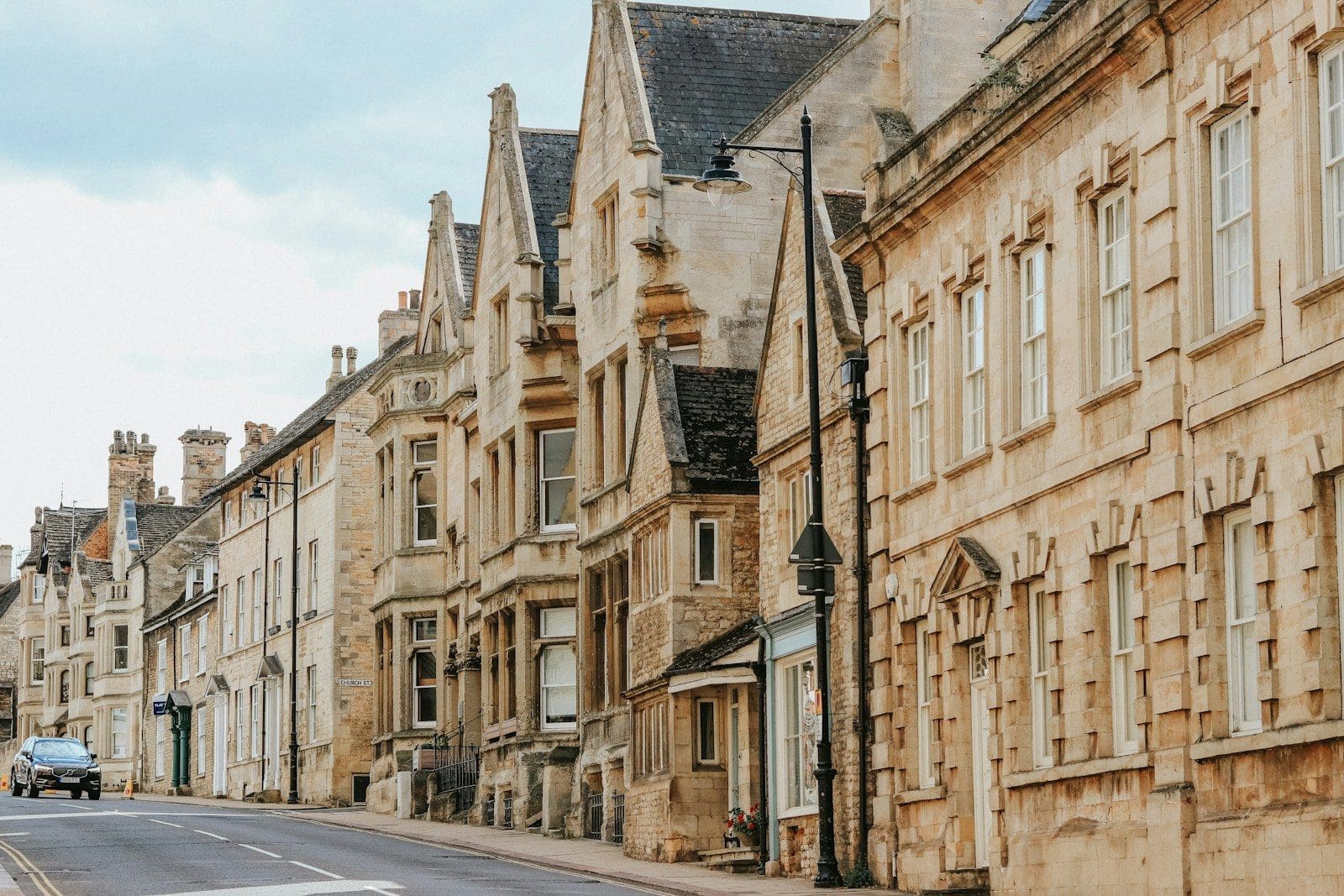
Stamford Looks Like It Has Been Carefully Edited
Stamford is almost suspiciously handsome.
There are towns with nice streets. Then there is Stamford, which appears to have been arranged by someone with a strong view on stone, proportion, and not letting modern ugliness get too confident.
It sits in south Lincolnshire, close to the River Welland, with mellow limestone buildings, narrow lanes, old churches, independent shops, and the sort of market-town polish that makes visitors slow down without being told.
This is not a loud place. Stamford does not need to shout. It has honey-coloured stone and centuries of good angles. That tends to be enough.
Why Stamford Is Famous
Stamford is famous for its historic streets and fine architecture.
It has long been praised as one of England’s loveliest stone towns. That is not just brochure talk, though brochures do enjoy a good adjective. The town has hundreds of listed buildings and a strong conservation story. In 1967, Stamford became England’s first conservation area, which tells us two things. First, the town was special. Second, people had already noticed before anyone could ruin it too badly.
The town grew around the River Welland and old routes. Its wealth came through trade, coaching, wool, and all the useful movement that made market towns matter.
Today, it is known for its Georgian streets, medieval churches, independent shops, cafés, markets, and easy access to Burghley House.
That is a tidy list. Stamford would probably approve.
A Town Made for Wandering
The best way to see Stamford is on foot.
This is not a place to charge through. It rewards slow wandering. Turn down side streets. Look at doorways. Notice rooflines. Follow lanes that seem too narrow to matter. They often matter.
The town centre is compact enough for a relaxed visit. You can move from shopping streets to churchyards, from the river to cafés, from handsome façades to small courtyards.
This is where Stamford works so well. It does not depend on one big attraction. The whole town is the attraction. The pleasure is in the mix.
We can enjoy a coffee, browse a shop, cross the river, admire a church tower, and then pretend this was the exact route we planned. Nobody needs to know.
The River Welland
The River Welland gives Stamford a softer edge.
Many historic towns can feel all stone and traffic if we catch them on the wrong day. Stamford is saved by the river and its meadows. They add space, light, and a quieter rhythm.
A walk near the water helps balance the busier town centre. It also gives us a better feel for why the town developed here. Rivers were not decorative in the past. They were routes, resources, boundaries, and working parts of the landscape.
Now, the river gives us a pleasant stroll and a reason to pause.
That is progress of a sort.
Churches, Stone and Serious Old Beauty
Stamford has a remarkable collection of churches for a town of its size.
Their towers and spires help shape the skyline. They also remind us that this was once a place of wealth and importance. Fine stone churches do not appear because a town had a quiet century and a loose change jar.
The buildings give Stamford depth. It is not just pretty. It is layered. Medieval, Georgian, Victorian, and modern life sit close together. This is one of the reasons film and television crews like places like Stamford. The past is still visible without too much squinting.
For visitors, this means there is always another corner worth seeing.
Independent Shops and Market-Town Energy
Stamford’s shops are part of its appeal.
The town has a good mix of independent retailers, cafés, food spots, and small businesses. It feels lived in, not preserved under glass. That matters.
A place can be beautiful and still dull if it has no working life. Stamford avoids that. It has polish, yes, but it also has people doing errands, meeting friends, buying lunch, and complaining about parking like any healthy English town.
The market adds to this. A proper market gives a town rhythm. It brings in movement, conversation, and the small drama of people deciding whether they need cheese, flowers, bread, or all three. Usually all three.
Burghley House Is the Big Neighbour
Burghley House sits on the edge of Stamford and adds another major reason to visit.
It is one of England’s great Elizabethan houses, built by William Cecil, Lord High Treasurer to Queen Elizabeth I. That is not a small CV line. The house, gardens, parkland, and events make it a major day out on their own.
For a short break, Stamford and Burghley pair very well. One gives us town streets, shops, churches, and cafés. The other gives us grand rooms, gardens, deer park, and estate scale.
Together, they make Stamford much more than a quick stop. Elsewhere in south Lincolnshire, Belton House and Estate makes another strong country-house day out.
Is Stamford Too Polished?
A little. But in a good way.
Stamford can feel very neat. Some towns wear their rough edges proudly. Stamford has filed most of its rough edges down and arranged them behind a tasteful frontage.
That may not suit everyone. If we want grit, noise, and chaos, we may need to look elsewhere. But if we want an easy, attractive day out with history, food, shops, and a good walk, Stamford is hard to beat.
It is beautiful without being ridiculous. Mostly.
Best Things to Do in Stamford
Start with a slow walk through the town centre. The official Visit Lincolnshire guide to Stamford is useful for current visitor information before you go.
Do not rush to tick things off. Look at the buildings. Explore the side streets. Visit the churches if they are open. Walk by the River Welland. Browse the independent shops. Stop for coffee. Then wander again.
If you have more time, add Burghley House.
If you have even more time, stay overnight. Stamford is better when we are not watching the clock. The town changes as day visitors leave and the streets settle.
That is often when handsome places become more real.
Is Stamford Worth Visiting?
Yes.
Stamford is one of Lincolnshire’s strongest visitor towns. It has beauty, history, shops, food, walks, and a major stately home nearby. It is easy to enjoy and hard to forget.
It also feels different from much of the county. Lincolnshire is often big skies, flat fields, working towns, and quiet villages. Stamford brings honey stone, Georgian streets, and a touch of stage-set elegance.
Not a bad thing.
We all deserve a little elegance now and then, provided it does not start charging London prices for a sandwich.
Where the Stone Does the Talking
Stamford does not need much selling.
The streets do the work. The river helps. The churches add height. The shops add life. Burghley waits nearby with a grander mood.
It is a town for wandering, not rushing. A town for looking twice. A town that seems to understand the value of being quietly excellent.
Rather smug of it, really.
But fair.
For a useful comparison with another attractive English market town, this guide to Kingsbridge shows how independent shops, walkable streets and a strong local identity can give a smaller town far more character than its size suggests.