There are places that try very hard to impress you. Frampton Marsh does not bother with any of that. It sits on the edge of The Wash near Boston, all reedbeds, wet grassland, freshwater scrapes and saltmarsh, and then lets the sky do the theatrical work. That turns out to be enough. More than enough, really. This is one of those Lincolnshire landscapes that looks simple at first and then, quite politely, gets under your skin.
What makes Frampton Marsh so satisfying is that it works on two levels at once. It is a serious wildlife reserve in a nationally important estuary system, but it is also just a very good place for a walk. Not a punishing walk. Not a walk that ends with you wondering why you agreed to this nonsense. A proper, open, big-sky stroll where you can hear birds before you spot them and where the horizon seems to have ambitions of its own.
Why this place feels bigger than it is
Frampton Marsh covers 172 hectares and lies between the outfalls of the River Witham and the River Welland. It is part of the most mature saltmarsh in The Wash, and that matters because The Wash is not just another stretch of coast. The RSPB describes it as the UK’s most important estuary for birds, and the wider estuary supports more than 400,000 non-breeding waterbirds, with internationally important numbers of species such as knot, dunlin, redshank, oystercatcher and curlew. In other words, this is not a decorative bit of marsh with a pleasant car park. It is proper habitat on a serious scale.
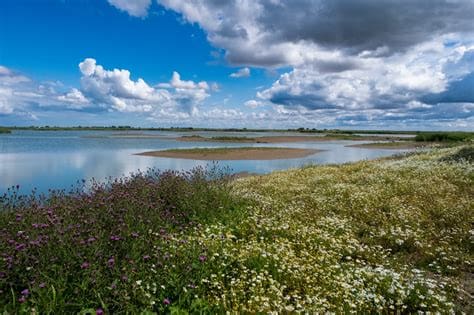
That scale is part of the appeal even if you are not the sort of person who keeps a life list in a weatherproof notebook. For a useful town-and-marsh pairing, nearby Boston, Lincolnshire adds the Fenland port story. You feel the openness straight away. The marsh seems to widen the air around you. There is very little clutter. No dramatic woodland reveal. No carefully staged viewpoint. Just water, grasses, reeds, birds and huge weather moving across the flatlands. It is beautiful in a distinctly eastern-English way. Subtle at first, then oddly addictive.
The walk itself is the point
The best thing about walking at Frampton Marsh is that it is mercifully flat. That sounds faint praise, but in Britain a flat walk with excellent views and plenty to look at is nothing to sneer at. The Wash Trail is 3.5 km and takes about 1 hour 15 minutes, passing through reedbeds, scrapes, wet grassland and saltmarsh, and taking in all three hides. The longer Grassland Trail is 4.5 km and takes around 1 hour 45 minutes. The Reedbed Trail is mostly flat, and the reserve notes that it is good for pushchairs too.
That makes the reserve feel welcoming rather than exclusive. You do not need to be a hardened birder in specialist outerwear. You do not need calves like a Tour de France rider. You can simply turn up and walk. Slowly is best. Frampton rewards dawdling. Stop by a hide. Lean on a rail. Listen to the reedbeds. Stand on the sea bank and do that very British thing where you pretend not to be impressed while being entirely impressed.
Big skies, louder birds
The title promises birdsong, and Frampton does not come up short. In summer the reserve is known for avocets, redshanks and skylarks, while winter brings thousands of ducks onto the freshwater scrapes. The RSPB also highlights boxing hares and hunting hen harriers, which tells you something about how lively this place can feel even on a cold day. This is not a reserve where everything is hidden two postcodes away. Wildlife is often close enough to feel part of the walk rather than a separate technical exercise.
But most of all, Frampton Marsh is famous for waders. Visit Lincolnshire calls it a “wader honey pot” on the East Atlantic flyway, noting that in peak spring and autumn migration it is possible to see 25 different wader species in a few hours and more than 100 bird species in a day. High tides can push thousands of birds over the sea bank and onto the pools and grassland to roost. That is the sort of spectacle that makes even casual visitors pause, lower their voices and pretend they always meant to come here.
And this is not only brochure talk. Recent county sightings from late winter and early spring 2026 at Frampton Marsh included Tundra Bean Goose, Russian White-fronted Goose, Peregrine, Spoonbill and Avocet. The reserve also posts daily sightings on its Facebook page, usually around 5 pm, which is useful if you like a little intelligence before setting out instead of relying on hope and a flask.
A reserve for all seasons
One reason Frampton Marsh works so well as a day out is that there is no bad time to go, only different versions of good. Spring brings movement and noise. Summer brings breeding birds and long views across flower-rich margins and lagoons. Autumn is migration, which means variety and the pleasing chance that something uncommon may drop in. Winter brings flocks, raptors and that hard, clear light that makes the marsh feel even larger. If winter wildlife is your thing, the Donna Nook seal-season walk is another Lincolnshire outing worth planning carefully. The official reserve page is quite right to say that whichever season you visit, there is wildlife to watch and trails to tromp.
The landscape helps here too. Lincolnshire Wildlife Trust notes sea-lavender, sea aster and sea-purslane across the saltmarsh, cut through by creeks, including one on the old course of the River Witham. For a longer coastal walk, the Skegness to Gibraltar Point route carries the same big-sky Lincolnshire mood farther north. So even when the birding is quieter, the setting still has texture. Frampton is not one of those places that only works if a rarity has turned up. It has enough atmosphere to carry an ordinary day, which is probably the truest test of a good reserve.
Practical bits that matter more than glossy adjectives
For a place that feels wild, Frampton is refreshingly straightforward. The official RSPB guide to Frampton Marsh is the best place to check current access, facilities and visitor details before setting out. The reserve, hides and car park are open 24 hours, while the visitor centre, toilets and café currently run from 10 am to 4 pm. There is no need to book in advance for general entry, and non-members pay £6 per vehicle. The café serves hot and cold drinks, light lunches and homemade cakes, which is exactly the level of civilisation most of us want after an hour staring nobly into a marsh wind.
It is also more accessible than many nature sites. There are accessible toilets in the visitor centre, Blue Badge parking close by, and the Reedbed Trail is mostly flat compacted aggregate. Families are well served too, with pushchair-friendly walking and a visitor centre that looks out over the reedbed lagoon. Dog owners need to pay attention, though. Dogs are allowed on public footpaths, the sea bank and the Grassland Trail if kept on a lead, but not on the Reedbed Trail, the paths to the hides, or inside the visitor centre or café. Frampton is generous, but not recklessly so.
Why Frampton Marsh stays with you
What lingers after a visit is not just the bird list. It is the feeling of space. The soundscape too. Wind over reeds. Skylarks overhead. Geese calling somewhere out on the marsh. Water moving in shallow channels. Frampton has that rare knack of making you slow down without lecturing you about wellbeing. It simply offers enough room, enough life and enough sky for your mind to stop behaving like an overcrowded inbox.
That is why this reserve works so well for both keen birders and ordinary walkers. If you know your godwits from your greenshanks, Frampton can be superb. If you do not, it still gives you a clean, open, deeply satisfying walk in one of Britain’s richest coastal landscapes. The birds are the headline act, certainly. But the real trick is that the whole place feels composed. Useful paths. Fine views. Good facilities. Serious wildlife. Very little fuss. It is all almost suspiciously competent.
Where the horizon earns its keep
Frampton Marsh RSPB is one of the best walks in Lincolnshire because it never tries too hard. It gives you space, movement, birds, weather and a sense that the east coast is still gloriously bigger than we usually allow for in daily life. You leave feeling better for having been there, which is an unfashionably useful quality in a day out. For big skies, birdsong and a walk that is genuinely worth your time, Frampton Marsh is quietly excellent. The sort of place we should be rather pleased still exists.
Because Frampton Marsh is best enjoyed with a bit of care for wildlife and other visitors, this practical guide to trail etiquette is a useful companion for anyone planning a walk through sensitive outdoor spaces.