Boston in the United States did not invent its name. It borrowed it. The Boston most people picture today, with red-brick streets, universities, and a strong opinion about baked beans, was named after Boston in Lincolnshire, England.
That is the whole story, if you only want the headline.
But names are never only names. They carry people, faith, money, weather, and the odd bit of ego. In other words, the name “Boston” crossed the Atlantic because a particular group of English settlers wanted a familiar anchor in a new and often unfriendly place. They also wanted the comfort of home, without some of the rules they were leaving behind. That part is always implied, even when nobody says it out loud.
The naming link between the two Bostons
For the wider local picture, see what Boston, UK is famous for. Boston, Massachusetts, was founded by English settlers in 1630. Early on, the settlement was known by other names. “Shawmut” appears as an Indigenous name for the peninsula, and “Trimountaine” shows up among the English settlers, a practical label for the three hills they noticed.
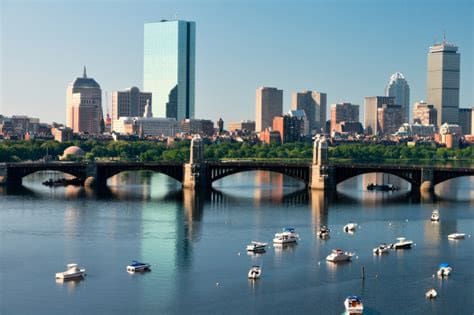
Then the settlers made a formal choice. They renamed Trimountaine as “Boston,” drawing directly from Boston in Lincolnshire. Several prominent colonists had strong ties to that Lincolnshire town. The records and later histories point to that English connection as the reason the name stuck.
There is a small wrinkle in the date, because the 1600s enjoyed nothing more than calendar confusion. Some accounts place the naming decision on 7 September 1630, while other sources cite 17 September 1630 using “new style” dating. Either way, it happened in September 1630, right at the start of the Massachusetts Bay story.
So yes, Boston in the US was named after a town in England. It is not a myth. It is not a marketing line. It is simply how a lot of New England got its map labels.
Why the settlers picked Boston, Lincolnshire
If you look at a list of English towns, “Boston” is not the obvious choice for a showpiece. It is not York. It is not Bath. It is not even Skegness, which at least has the decency to be memorable.
Boston in Lincolnshire mattered for three reasons that fit the early New England mindset.
First, it was a serious port town in medieval England. Boston sat on the River Witham and reached the sea by waterways that mattered for trade. At its height, it was a wealthy trading centre. It was linked to European markets, and later became associated with the Hanseatic trading world. Some modern heritage accounts describe it as one of England’s most important ports in its prime, especially for wool and other goods.
Second, it had a strong Puritan and New England story. The early 1600s in England were tense for nonconformists. Boston, Lincolnshire had a growing Puritan congregation and a preacher who would become famous on both sides of the Atlantic, the Reverend John Cotton. He served at St Botolph’s Church in Boston, Lincolnshire, and later left for New England.
Third, it had the sort of landmark you remember even if you try not to. St Botolph’s Church, known locally as the “Boston Stump,” dominates flat fenland for miles. The tower has been used as a beacon and a navigation point for centuries. It is an easy symbol for a town that wanted to be noticed from a long way off.
Put those together and you get a neat package for settlers in Massachusetts Bay. They could carry a familiar name that hinted at trade, faith, and identity. Also, it was short, easy to spell, and far less awkward than “Trimountaine.”
The people behind the name
The “who” matters because it explains why Lincolnshire, not some other English place, got the honour.
One commonly cited figure is Isaac Johnson, a leader among the early settlers. Accounts of Boston’s early history describe him naming the settlement “Boston” after the town in Lincolnshire linked to his own background and circle. This overlaps with the wider Puritan network that connected Lincolnshire, Cambridge, and the Massachusetts Bay leadership.
John Cotton also looms large in the story, even when he is not the one holding the pen. Cotton served as minister at St Botolph’s Church in Boston, Lincolnshire, before emigrating to New England. His reputation, and the wider group around him, helped shape the religious tone of early Massachusetts. So the name “Boston” worked as a nod to a place and to a movement.
This is also why the connection keeps resurfacing in historical accounts. It is not just a neat fact for a pub quiz. It is a clue to who the early settlers were and what they valued.
Where the English Boston got its own name
Boston, Lincolnshire did not appear out of thin air either. Its name is widely linked to St Botolph, an Anglo-Saxon saint associated with travel and boundaries. Over time, “St Botolph’s town” was shortened and smoothed into “Boston,” which is what language tends to do when it is late for work and hates extra syllables.
Modern explanations often describe “Boston” as a contraction of “Botolph’s town,” sometimes also linked to older forms like “Botolphston” or “Botulfeston” in historical records. The details vary by source, but the St Botolph link is consistent.
This matters because it makes the Atlantic jump feel less random. The American city was named after an English town, and the English town was named after a saint tied to travel. The symbolism writes itself, which is always handy when you are building a new society and need stories that feel inevitable.
The church that keeps showing up in the background
If you want a single physical object that ties the two Bostons together, St Botolph’s Church is the best candidate. It is massive, medieval, and hard to ignore. Heritage descriptions point out that it was built when Boston was wealthy and outward-looking, and that its tower acted as a beacon for travelers. It is also explicitly linked, in modern heritage writing, to the Puritan congregation and early colonization of New England.
There is also a cultural echo here that feels very British. The church is called the “Boston Stump,” a nickname that sounds affectionate, slightly rude, and entirely normal. It is the sort of name you give something you see every day, especially if it keeps reminding you how small you are.
Why this naming story still matters
It is tempting to treat place-name origins as trivia. They are not. They tell us how power, memory, and identity work.
For New England, English place-names acted like a portable map of belonging. Settlers named places after the towns they came from, the counties they missed, and the saints they still respected, even when they were quietly redesigning religion to suit their new lives. Boston is one of the clearest examples because the link is direct and well documented.
For Boston in Lincolnshire, the American connection is both flattering and slightly ironic. The English town is older, and in medieval trade terms it had its own moment of serious importance. Yet today, outside the UK, the name “Boston” usually points across the ocean. Lincolnshire gets the role of origin story, which is a very British outcome. We supply the backstory. Somebody else gets the blockbuster.
Still, that backstory is useful. It reminds us that Lincolnshire’s fenland towns were not isolated corners. They were connected to Europe by trade routes, to Cambridge by education networks, and to New England by migration and faith.
A practical way to remember it
If you want a simple mental hook, it goes like this. For current information about the English town behind the name, the Visit Lincolnshire Boston guide gives useful visitor context.
Boston in Massachusetts was named after Boston in Lincolnshire.
Boston in Lincolnshire is tied to St Botolph, and its church became a landmark for travellers.
Then the name travelled again, and again, because people keep reusing familiar words when they build new places.
It is not poetry. It is habit. But most of history is habit, dressed up later as destiny.
A Name That Still Travels
Boston’s English origin is one of those facts that stays true no matter how many times it gets repeated. It is also a reminder that the Atlantic world was built on networks, not isolated events. A town in Lincolnshire, a church tower on flat fenland, and a Puritan migration in 1630 helped set the label for a future American city that would later export its own culture back to us in bulk.
If the link between Boston in Lincolnshire and Boston in Massachusetts has caught your interest, FootageVault offers more history-focused material for following stories that travel across places and generations.