Boston in Lincolnshire is not a place that begs for attention. It does not do sparkle. It does not do “Instagram village” either. What it does have is weight. Real history. Real working-town energy. And a skyline that is basically one enormous church tower daring the flat Fens to look interesting.
So yes. Boston, England is worth visiting, if we arrive with the right expectations. This is a town for slow wandering, odd corners, and big stories told in a calm voice. Not for shopping bags and late-night cocktails. Boston can manage a market, a windmill, a riverside, and a solid cup of tea. It will not pretend to be Barcelona. That is, in its own way, a relief.
What Boston feels like on the ground
Boston is a market town and port with the kind of streets that make sense once you stop trying to “do” them quickly. You walk. You look up. You notice brickwork. You cross the river. You circle back. In other words, it rewards attention more than speed.
It also feels honest. Some places are polished until they squeak. Boston is not one of them. It is a town where people live, work, and get on with it. That lived-in feel is part of the point.
The headline sight that makes the town make sense
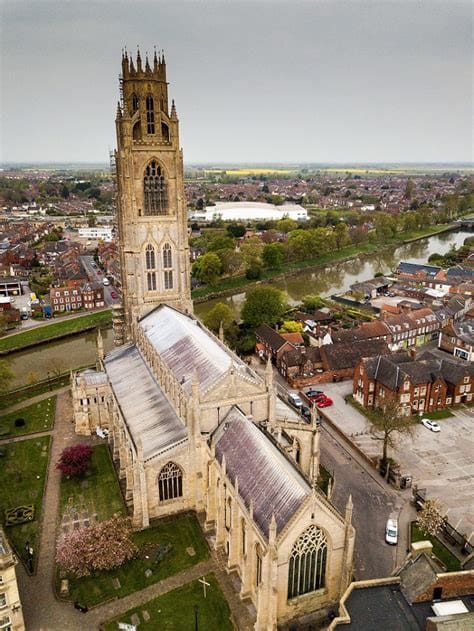
St Botolph’s Church, the Boston Stump
Start with the Stump. Not because you have to. Because it is there, and it is impossible to ignore. St Botolph’s Church is open to visitors most days, and entry is generally free, with charges for experiences like climbing the tower.
Inside, it is calm, airy, and bigger than you expect. Outside, the tower anchors the whole town. Boston sits in the Fens, so the skyline has no distractions. The Stump becomes your compass. You will keep spotting it, even when you are sure you have walked far enough away.
If you do one paid thing in town, make it the tower climb. It turns Boston into a map, and it turns the flat landscape into drama.
The medieval bits, without the velvet rope
Boston Guildhall Museum
Boston’s history is not just “old”. It is properly significant. The Boston Guildhall is a surviving medieval civic building that now works as a local museum, and it is free to visit, with set opening days and hours.
This is where Boston’s story gets sharp edges. Trade, guild power, law, punishment. The town’s links to the Pilgrims are also part of the Guildhall narrative, including the famous imprisonment story that ties Boston to a much larger Atlantic history.
It is an easy visit, but it leaves you with a sense of scale. Boston was not a sleepy backwater. It was connected, ambitious, and busy.
The Boston that still runs on Wednesdays and Saturdays
Boston Market
Markets can be cute. Boston Market is more useful than cute, which is better. The main market runs every Wednesday and Saturday, with an additional Makers and Farmers Market on the last Saturday of the month between March and October.
This is the place to see the town as it is, not as a brochure would like it to be. You get proper produce, proper chatter, and that familiar British skill of conducting a full social life while standing beside a van of vegetables.
Go early. You get better browsing and less weaving.
The windmill that keeps showing off
Maud Foster Windmill
Maud Foster Windmill is the sort of attraction that sounds niche until you see it. Then it becomes the thing you tell people about later. It is a tall working windmill and a rare survival, with visitor access on specific days and times.
It also has the quiet magic of machinery that still does its job. Gears. Flour. Wind. No screens required. On a good day, you get the sense that Boston’s past is not locked in a display case. It is still turning.
Plan around its opening days. Instead of being annoyed, treat it as a reminder that not everything exists for our convenience.
Water, big skies, and the town’s other storyline
Boston is shaped by water. The river is not just scenery. It is the reason the town became important, and the reason it still thinks like a port.
In modern Boston, flood management is a very real part of local life, including major flood defence work designed to protect homes and businesses.
This matters for visitors too, because it explains the landscape. The Fens are engineered. They are beautiful, but in a controlled, hard-won way. After more than a few minutes walking by the water, you feel that mix of nature and human effort.
Boston Belle river and sea trips
If you want the water story in motion, there are boat trips. Boston Belle offers cruises on the River Witham and trips out towards The Wash, including wildlife-focused sailings.
This is a surprisingly strong add-on to a Boston day. You get the town from a new angle, and you see how quickly “market town” turns into “big open horizon”.
Parks and walks that are better than they sound
Boston is not a hiking base camp. It is better than that. It is a place for gentle walking, where flatness becomes a feature.
Central Park and easy breathing space
Central Park is a solid town park with the basics done well, and it is often used for local events.
It is a good reset in the middle of a day. Sit down. Watch families doing family things. Feel briefly smug about not being in a car park.
Witham Way Country Park
Witham Way Country Park is another simple win, with paths and a trim trail, and it links neatly to the “walk it off” side of the town.
This is Boston at its most low-key, which is often when it is at its best.
The nearby surprise that turns a Boston visit into a weekend
Frampton Marsh
Just outside town, Frampton Marsh is one of those places that makes you stop talking. Big skies, wetlands, and birds doing bird things at scale. The reserve has visitor facilities and a network of accessible paths.
This is a brilliant pairing with Boston itself. Town in the morning. Marsh in the afternoon. History and horizons in one trip.
It also suits real life. Not everyone wants a packed itinerary. Sometimes we just want space.
Evenings that do not involve pretending
Blackfriars Theatre and Arts Centre
Boston’s evening options are not endless. That is fine. But there is culture, and it is practical culture. Blackfriars Arts Centre has a regular programme of shows, films, and touring productions.
If your day ends with a performance and a quiet drink, Boston suddenly feels like a proper little break, not just a stop.
A simple one-day plan that works
This route keeps walking easy and decisions minimal. For current attractions and practical visitor details, the Visit Lincolnshire Boston guide is worth checking before we set out.
Morning
- Boston Market first, if it is a Wednesday or Saturday.
- St Botolph’s Church next, with the tower climb if you want the full view.
Lunch
- Keep it simple in town. A café, a bakery, something warm. Boston does not demand a tasting menu.
Afternoon
- Boston Guildhall Museum for the story and the atmosphere.
- Walk riverside for a while. Let the town slow down.
- Finish at Maud Foster Windmill if it is open that day.
Evening
- Blackfriars if the programme suits.
- Otherwise, an early night and the radical joy of being well-rested.
When Boston is most worth your time
Spring and early autumn suit Boston well. You get decent daylight, fewer weather tantrums, and the town feels more open. Market days add energy. Wind adds drama at the windmill. Big skies stay big.
If you want Boston at its calmest, pick a weekday and treat it like a slow reset. If you want Boston at its most itself, pick a market day.
Who Boston suits, and who it does not
Boston is worth visiting if we like:
- Big churches and the kind of history you can touch
- Markets that sell actual things people use
- Industrial heritage and working machinery
- Quiet walks, riversides, and wide open landscapes
- Places that feel real, not curated
Boston is less worth visiting if we need:
- A glossy city break
- Constant entertainment
- Designer shopping and big nightlife
- Attractions lined up like a theme park
In other words, Boston rewards a certain mood. Slow. Curious. Slightly nosy about how places work.
A quiet recommendation with a very tall tower
Boston will not try to charm us with tricks. It does not have to. It has the Stump, the Guildhall, a proper market, and a windmill that still means business. It also has space, sky, and a sense of place that is hard to fake.
So yes, it is worth visiting.
Just bring good shoes. And a mild tolerance for wind.
If Boston has persuaded you that quieter English towns can make very good day trips, Lebun’s UK travel coverage is a useful place to find more heritage-led places to explore.