The history, why it mattered, what replaced it, and where the “flower town” identity stands today
Spalding has a knack for being politely famous. Not loud-famous. Not “coachloads of influencers” famous. More the old kind, where people arrive with flasks, fold-up chairs, and a steady faith in British weather.
For decades, one event summed it up. The Spalding Flower Parade. A moving show of floats covered in flowers. It was local pride, local work, and local growing, all rolling past the chip shop.
Then it stopped. Then it came back. Then it paused again. Spalding, as ever, stayed calm and carried on.
This is the story of the parade, what it did for the town, what filled the gap, and what the “flower town” label means now. For the wider context, our guide to what Spalding is famous for fills in the rest.
Spalding Flower Parade at a glance
Here is the simple timeline, without the nostalgia, but with most of the drama.
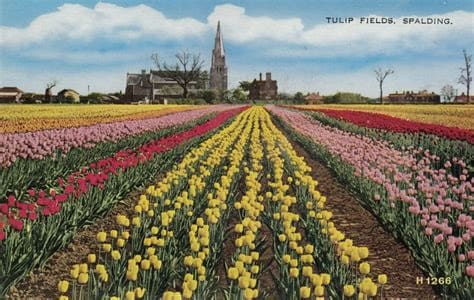
- 1920s–1930s: “Tulip time” becomes a real thing, with visitors coming to see the fields.
- 1935: A royal jubilee lines up with peak bloom, and the crowds get serious.
- 1948: Organised “Tulip Week” routes help manage the chaos.
- 1959: The first official Spalding Tulip Parade takes place.
- 1959–2013: The parade runs for 55 years, then ends.
- 2023–2025: Volunteers revive it and run three parades in a row.
- 2026: The event is deferred, with plans to return in 2027.
If you like neat endings, this will test you a bit.
Then: when tulips ran the town
Spalding sits in the South Holland district of Lincolnshire, on fenland that was made, drained, and managed. The soil is rich. The land is flat. The sky is large. It is not showy. It is productive.
That matters, because the parade was never just “a nice day out”. It was a public face for an industry. Spalding grew into a centre for bulb growing. That brought jobs, links abroad, and a spring season that felt almost unreal when the fields were in full colour.
By the early 20th century, people were already travelling to the area just to see the tulips. When the crowds grew, the problem was not interest. The problem was traffic.
So Spalding did what Spalding does. It organised.
How the parade began, and why 1959 mattered
The roots go back before 1959. In the 1930s, tulip growing expanded fast around Spalding. In 1935, the King George V jubilee landed at the same time as peak bloom. People arrived in huge numbers and jammed the lanes. That pressure pushed the area towards planned routes and “tulip time” events.
After the war, the organised version arrived. In 1948, growers helped set up a “Tulip Week”, including a planned tour route to guide visitors. By 1950 it had grown into “Tulip Time” across set weekends.
Then came the key twist. To grow strong bulbs, growers remove many flower heads. Those heads were usually a by-product. The bright part had done its job. But someone saw value in the “waste”. Tulip heads could be stored and used for decoration.
So in 1959, the first Tulip Parade took place. It used those saved flower heads to cover floats in colour. A single float could be up to 50 feet long and use as many as 100,000 tulip heads. That is not a metaphor. That is a craft project with consequences.
Within a few years, the parade was well known far beyond Lincolnshire. At its height, the town pulled in huge crowds, plus a static display so people could see the floats up close for days after.
Spalding had turned local growing into a public spectacle. It was tourism, but also proof. Proof that the town made something real.
What the parade looked like in its peak years
If you only know modern parades, picture something both more home-made and more impressive.
- Floats on themes: big builds with titles, jokes, and a bit of ambition.
- Flower royalty: a Tulip Queen, later a Flower Queen, front and centre.
- Bands and groups: local clubs, performers, and visitors, all part of it.
- A town in motion: roads closed, shops busy, people everywhere.
- A static show: time to inspect the detail, because you would miss it at 3 mph.
And the detail mattered. Each tulip head had to be pinned on. By hand. With care. Often by volunteers who later claimed they “enjoyed it”, which is a very British way of saying their fingers never forgave them.
It also created a shared rhythm. Spalding did spring in a special way. The parade made that feel official.
Why it mattered, beyond the obvious beauty
It is easy to say it mattered because it was pretty. It was. But that is not the main point.
It sold the local story
The parade advertised Spalding’s bulb industry in the most direct way possible. You could not ignore it. It came to you. It was not a leaflet. It was a 50-foot float covered in flowers.
It brought money into town
Visitors meant packed pavements, busy cafés, full car parks, and trade for shops. Even when the parade felt old-fashioned, it still pulled people in.
It gave people a shared job
This is the bit outsiders miss. A parade like this is not “put on” by magic. It is made. Over weeks. In sheds. With pin boards, glue, and endless cups of tea.
That kind of work builds identity. Not the branding kind. The real kind.
It linked Spalding to a wider world
Spalding’s bulb story has long links to the Netherlands and to wider horticulture. The parade made those links visible. It helped the town feel connected, not tucked away.
So yes, it looked lovely. But it also told a story about who the town was.
The long pause: why the parade ended in 2013
The short version is money. The longer version is also money, but wearing a high-vis jacket and holding a clipboard.
By the 2000s, the backdrop had changed.
- Bulb growing had declined in the local area, as growers shifted to other crops and the industry changed shape.
- Crowds fell from peak-era numbers to much lower attendance by the early 2010s.
- Costs rose, especially for safety, traffic control, and running a major event in modern Britain.
- Public funding faded, and the parade became harder to justify as a council spend.
In 2013, the 55th parade took place, and then it stopped.
There is a quiet tragedy in that, because the parade did not fail as a concept. It failed as a budget line. It turns out flowers do not exempt you from insurance.
What replaced it after 2013
Nothing replaced it properly. Not in one neat package. But Spalding did not become colourless overnight.
Instead, the “flower town” identity broke into smaller pieces.
Springfields Festival Gardens carried the torch
Springfields Festival Gardens were built as a “shop window” for the bulb industry, and they became a lasting way to see spring colour without needing a parade day. The gardens began in the 1960s and drew huge numbers in their early years. Over time, the wider Springfields site evolved, but the gardens stayed as a key place where Spalding’s bulb story could still be seen and felt.
In other words, when the parade was gone, the gardens still said, “This is who we are.”
Churches and local displays filled the gap
South Holland has a strong tradition of church flower festivals and seasonal displays. These are not a like-for-like replacement. They are quieter. But they keep floral craft alive, and they spread visitors around the area in a gentler way.
“In Bloom” thinking returned
When big events vanish, towns often drift. Spalding did not drift forever. In recent years there has been fresh focus on public planting, tidying, planters, and In Bloom efforts across the district. That is not as thrilling as a flower dragon on wheels, but it does something important. It puts flowers back into everyday streets, not just onto floats.
The town’s main identity widened
Spalding’s economy has become more closely tied to food, packing, and wider agri-business. The land is still productive. The town is still shaped by growing. It is just not only bulbs.
So the “flower town” label did not vanish. It became less dominant, and more symbolic.
Now: the parade revival in 2023–2025
After a decade without it, the parade returned in 2023. Not because someone found a spare pot of council cash. It came back because volunteers raised money and rebuilt the machine from scratch.
The revived format kept the spirit but adjusted the shape.
- A parade route through town, with a clear start point and planned closures.
- A hub at Springfields, with stalls, displays, and space to manage crowds.
- Extra weekend activity, including float displays and community events.
It worked. The parade ran again in 2023, 2024, and 2025. That matters, because one year can be a novelty. Three years is a pattern.
And Spalding showed it still had the appetite for it. Crowds turned out. The town centre still drew people in to watch the floats pass through. Churches opened. Markets expanded. It looked, briefly, like the old rhythm was back.
Not identical. But recognisable.
2026 and beyond: the modern problem is still the same
In early 2026, organisers announced the 2026 parade would not go ahead. The reason was painfully modern and very familiar.
The event needed around £90,000 to run safely, covering things like security, road closures, and insurance. Organisers expected to be short. They chose to defer and focus on bringing the parade back in May 2027 instead.
This is the reality of “then and now”.
Back then, the hard part was pinning tulip heads onto boards. Now the hard part is paying for barriers, stewards, and paperwork. The float might still be 50 feet, but the forms feel longer.
Still, the key point is this. The parade is not dead. It is paused, regrouping, and aiming for a return.
So where does the “flower town” identity stand today
Spalding’s “flower town” status is not a fixed badge. The Visit Lincolnshire Spalding guide shows how that heritage still sits within the town’s visitor identity today. It is a story the town tells, and retells, depending on what is happening on the ground.
Today, we can say a few things with confidence.
The heritage is real
The parade existed for 55 years for a reason. The bulb industry shaped the area, the skills, and the spring season. The town’s links to horticulture are not invented for tourism leaflets.
The look has changed
The vast sea of tulip fields is not what it once was. The industry changed. Land use changed. The town changed. That can feel like a loss, and it is.
But the identity is not only about acreage. It is also about craft, memory, and how a place marks the seasons.
The culture is still active
Springfields Festival Gardens remain a visible sign of the bulb story. Flower festivals and town planting projects keep the idea alive. Even the council’s modern spring events still lean into flowers and arranging.
So the identity is not just a slogan. It is a habit.
The parade is now part of the identity, not the whole of it
In its peak, the parade was the headline. Now it is part of a wider set of things that make Spalding feel like Spalding.
That may be healthier. Less fragile. Less tied to one weekend.
But most of all, it means this. The town still wants colour. It still wants spring to feel like an event. And when it can, it still puts flowers on wheels and sends them down the road.
Ayscoughfee to Springfields, the bloom still fits
Spalding has learned a slightly awkward truth. A proud tradition can be loved by thousands and still be one funding gap away from trouble.
Yet the wider truth is better. The parade shaped the town for half a century. The pause after 2013 did not erase that. The revival proved the appetite is still there. And even in the “off” years, Spalding keeps finding ways to look like a flower town, without needing to shout about it.
Quiet pride. Rich soil. A bit of grit. And, when the timing is right, a parade made of petals.
Because the Flower Parade grew from Spalding’s bulb and flower trade, readers who enjoy that horticultural side of the story may also like Wright Gardens for more plant and garden reading.