In Tudor England, a “religious guild” was not just a pious club with a candle and a banner. It was a working part of the local machine. It raised money. It paid people. It kept buildings standing. It helped the poor. It funded lights, prayers, and small acts of care that made parish life feel steady.
A chantry did something similar. It supported priests, altars, and services for the dead. It kept the idea of memory alive in a very practical way: with wages, rent, bread, and routine.
Then Edward VI came to the throne, and that whole system was labelled a problem.
The dissolutions under Edward VI were not only a theological clean-up. They were also a financial sweep, and they changed towns in ways that still show up in the stones.
What were guilds and chantries really doing?
It helps to picture the medieval town as a place that ran on small endowments.
A guild might be formed by merchants or tradesmen. It might be dedicated to the Virgin Mary, a saint, or a parish church. The members paid in. Benefactors left gifts. Over time, the guild could hold land, collect rents, and build up a pot of assets that felt, to locals, like part of the town’s permanent furniture.
Chantries worked through a similar logic. A family, a merchant, or a local official set aside property so that prayers would be said for their soul. That sounds spiritual, but it was also economic. Someone had to run the services. Someone had to maintain the altar. Someone had to keep the lights burning.
So the “religious” side and the “community” side were tangled together. That tangle is exactly what later reformers wanted to cut.
The Edwardian Reformation needed more than sermons
Edward VI was young. The policies were driven by his government and advisers, and they moved England further into Protestant reform. For primary-source context on the religious changes of his reign, The National Archives provides a useful collection. In that world, masses for the dead and prayers linked to purgatory were not harmless traditions. They were treated as the wrong kind of religion.
But there was another need sitting beside the theology: money.
By the late 1540s, the crown had already shown what could be done by taking monastic assets. The machinery of seizure existed. The habit existed. And the state was not shy about using it.
Chantry and guild endowments looked like the next available cupboard to raid.
The legal hammer: the 1547 Act
The key law was the Dissolution of Colleges Act 1547, also widely called the Chantries Act of 1547. It authorised the taking of property from chantries, colleges, free chapels, and a long list of related foundations. That list is telling. It includes fraternities, brotherhoods, and guilds — not because every guild was identical, but because many held funds used for religious services and memorial practices.
In other words, if the money supported “superstitious uses”, it was at risk. And in practice, a great deal could be framed that way. If you were determined enough, even a candle could be suspicious.
So the law did not just close down priests at side altars. It pulled at the finances of local institutions that had, for centuries, helped to organise town life.
Surveys, commissioners, and the paperwork of loss
Large changes do not happen without paperwork. The Edwardian government sent commissioners to survey these foundations and their assets. New surveys were completed in 1548, and records like chantry certificates and rentals show how detailed the process could be.
This was not an abstract religious reform. It was inventory. It was valuation. It was seizure. And it was, for local people, the moment when something familiar was counted up and carried away.
There is a quiet irony here. Reformers often spoke in the language of spiritual correction. But the state’s tools were the tools of landlords: lists, rents, titles, and transfers.
“Superstition” as a category, and why it mattered
The word “superstition” did heavy lifting in the Edwardian period. It was not only an insult. It was a legal and political category.
If a practice was classed as superstition, it could be attacked, removed, and replaced. And it could be removed in a way that conveniently released its assets.
British History Online notes that the Chantries Act attacked chantries for encouraging “superstitious practices and errors”, and that secular guilds and fraternities were caught by the Act when their funds were used for those ends. That detail matters because it shows how wide the net could spread.
So even where a guild did practical charity, it could still be vulnerable if part of its spending supported religious services in the old style.
What did towns lose?
The immediate losses were obvious:
- Paid clergy roles disappeared. Many priests supported by endowments were displaced.
- Local charity took a hit. Guild funds often supported the poor, the sick, and communal care.
- Maintenance budgets vanished. Lights, repairs, and small daily costs that kept buildings and services running were suddenly not funded in the same way.
But there was also a slower loss: local control.
A town might accept reform, grumble, then adapt. What stung was the feeling that local endowments had been created for local use, and were now being swept into national hands.
Even when proceeds were meant to support “public good” aims, the reality often drifted elsewhere. Encyclopaedia Britannica, for example, notes the educational intention attached to the Chantries Act, but also how turmoil and politics could divert funds.
So the promise was public benefit. The experience, in many places, was subtraction.
Boston’s St Mary’s Guild: a clear example in brick
This is where the story gets tangible.
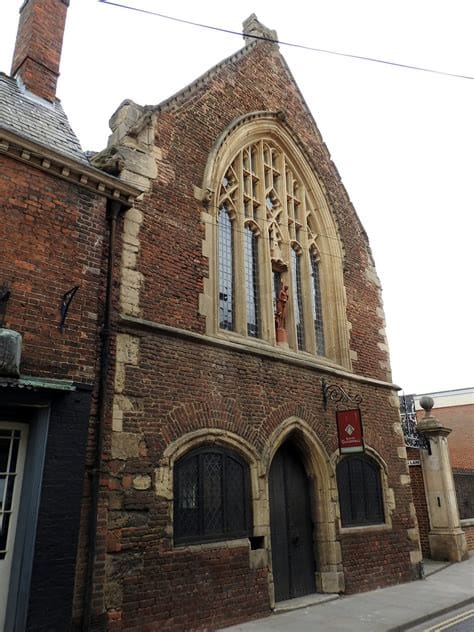
In Boston, Lincolnshire, local merchants formed St Mary’s Guild in 1260. Around 1390, the guild built a new hall on South Street — the building we now know as Boston Guildhall. The hall is still there, and it is one of the best ways to “see” what a powerful religious and commercial fraternity could become.
Boston’s Guildhall is also a neat demonstration of what happened when Edwardian reform reached into local life.
Multiple accounts of the building’s history describe its religious use ending with the dissolution of guild life and civic change in the mid-16th century, with the hall’s property seized and later associated with the Boston Corporation. A common thread is that the religious guild structure was broken, and the building moved into civic hands.
We can argue about the finer points of dates and processes in different records, but the larger point stays put: the guild’s religious foundation did not survive Edwardian policy as it had existed before.
From fraternity to corporation: power changes its coat
There is another irony here, and it is very English.
When the religious guilds and chantries were dissolved, towns did not stop needing governance. They did not stop needing places to meet, manage disputes, or run civic business. They still needed the machine. They just needed it in a different form.
So buildings and assets often shifted into municipal use. Boston’s own local history writing describes guild assets being transferred into the newly formed Boston Corporation in the 1540s, with senior guild members moving into civic leadership roles. In plain terms, the same local influence sometimes remained — but now dressed as civic authority instead of religious fraternity.
We can call that continuity. We can also call it survival instinct.
What did “dissolved” mean on the ground?
Dissolution was not a single moment. It was a process with several stages:
- Legal authority was granted by Parliament.
- Surveys were ordered and carried out.
- Assets were taken into the crown’s possession.
- Local arrangements changed: pensions, transfers, sales, grants, disputes, and bargains.
Records like the 1548 surveys show the state’s appetite for detail: property, rents, and obligations were identified so they could be redirected.
So “dissolved” often meant: the old institution stopped, but its assets kept moving, like water finding a new channel.
Why Edward VI’s reign made this feel sharper
Henry VIII had already broken with Rome and dissolved monasteries. So why does Edward VI’s reign feel like such a decisive blow for guilds and chantries?
Because Edward’s government pushed Protestant reform further into daily religious practice. The attack was not only on large monasteries, but on the smaller, more intimate structures of local devotion: prayers for the dead, side altars, lights, and the community funding behind them.
It reached into parish habits. It reached into the routines of memorial life. And it did it with enough speed that many communities had little time to soften the landing.
The buildings remain, but the purpose changed
Today, we meet this history in buildings like Boston Guildhall. It still stands on South Street. It is Grade I listed, and Historic England recognises it as a significant historic structure.
The building’s survival is part luck and part usefulness. After the religious function ended, the hall continued in civic use. Its later story also includes the 1607 Guildhall arrests, when the building took on a very different role in Boston’s history. It remained a place where authority gathered, which is a strong reason for a building to survive any century.
So when we stand in such a hall, we are standing inside a shift. The timber and brick did not move. The meaning did.
What we should take from this, without getting too dramatic
Under Edward VI, religious guilds and chantries were dissolved. That is the simple line.
But behind it sits a deeper truth: England’s Reformation was not only fought in pulpits and courts. It was fought in endowments, rents, and the small institutions that held communities together.
For many towns, the dissolutions did not just remove old theology. They rebalanced local power. They redirected local money. They changed what “community support” looked like.
And in places like Boston, we can still point to the exact building where a medieval merchant fraternity once anchored itself — before the Tudor state decided it knew better, and quietly took the keys.
The aftertaste of reform in a market town
There is one last irony worth keeping.
The dissolutions were often presented as a cleansing. A removal of error. A tidy-up of superstition. Very modern, in its way.
Yet the outcome was rarely tidy. It produced decades of disputes, transfers, compromises, and local adjustments. It shifted care from small endowments into larger systems that were not always ready to replace them.
So we are left with a familiar English pattern: grand change delivered by paperwork, followed by a long, slightly improvised effort to make daily life work again.
The guilds and chantries were dissolved. The towns carried on. They always do. But they carried on with different tools, and with a different story in the background.
When the candles went out, the town kept breathing
A guild candle is a small thing. A chantry stipend is a small thing. A rented strip of land left to fund prayers is a small thing.
But towns are made of small things.
When Edward VI’s government dissolved religious guilds and chantries, it did not only end a set of religious customs. It changed how towns paid for themselves, cared for themselves, and remembered their dead.
And if that sounds a little too emotional for Tudor policy, we can always fall back on the safest conclusion of all:
It was, at the very least, extremely efficient.
If the Tudor period and the way national policy reshaped local life interests you, FootageVault is another place to explore history through documentary-style video and archival material.