Sleaford is polite about most things. It does not shout. It does not pose. It gets on with it.
Then, right at the south end of the town centre, it places a dramatic stone spire in your line of sight and pretends this is normal.
That is the Handley Monument. It rises above Southgate like a Gothic exclamation mark. It is also one of those local landmarks that does two jobs at once. It honours a man, and it tells a story about the town that built it.
If you have ever drifted past it on the way to the shops, the station, or anywhere else with a purpose, you are in good company. The monument has seen generations of us do that. It is patient. It has had practice since the 1850s.
This is the deep-dive version. Not a grand tour. More a careful look, with our hands in our pockets, as is the custom.
Where the Monument Sits, and Why That Matters
The Handley Monument stands on Southgate, close to the point where the town centre begins to loosen its grip and let the road run outward.
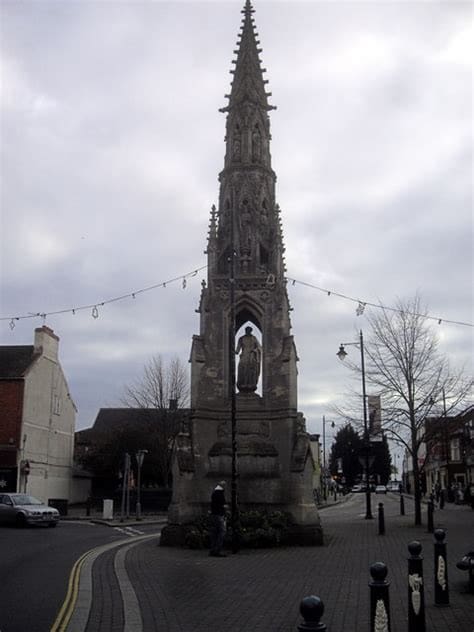
That position is not an accident. Southgate is one of the main routes through Sleaford. It is also a place where views open and close as you move. In other words, the monument is meant to be seen, and it does its job well.
Local heritage documents even call it a landmark that can be seen within and beyond the conservation area. It shares that skyline role with St Denys’ spire and Money’s Mill. The message is simple. If you want to understand Sleaford’s shape, you follow the tall things.
There is also a small open space around the monument. It should feel like a calm pause in the street. Sometimes it does. Sometimes the traffic disagrees.
The “Handley” in the Middle of It All
Henry Handley was born in Sleaford in 1797 and died in 1846. He was a Member of Parliament, and he had a strong interest in farming improvement and new power, including steam. He was not the sort of man who drifted quietly through public life.
He served as an MP in two stretches, including for Heytesbury and later for “Lincolnshire, parts of Kesteven and Holland” in the era after the Reform Act reshaped constituencies. After more than two decades in and around Parliament, he became part of that familiar local pattern: a national figure who still reads as “one of ours”.
He also had links to Culverthorpe Hall, just outside town. That matters because it places him in the landscape as well as the politics. He was not only a name on paper. He belonged to the local world of estates, farming, and improving schemes that defined so much of rural Lincolnshire in the 19th century.
But most of all, his story tells us what Sleaford valued. It valued service, influence, and the promise of progress. It also valued remembering.
Why Sleaford Built a Monument at All
The monument was funded by public subscription. In plain terms, people put money in a pot because they wanted a permanent memorial. The total raised was £942, which was a serious sum at the time.
This is worth pausing on. Public memorials are never only about the person. They are about the people doing the remembering.
A subscription tells us the town wanted to be seen as a place that honours its own, and does it with something solid and public. Not a plaque on a wall. Not a quiet note in a ledger. A tall stone structure in the street, where daily life cannot avoid it.
Instead of being tucked away in a churchyard, it stands where commerce and movement happen. It says, gently but firmly, that memory belongs in the middle of things.
What You Are Looking At: A Neo-Gothic “Eleanor Cross” in Miniature
Architecturally, the Handley Monument is a neo-Gothic memorial built in the form of an “Eleanor Cross”.
That phrase can sound lofty, but the idea is easy. Eleanor Crosses were medieval-style monuments, tall and richly carved. Victorian Britain loved that look because it suggested history, dignity, and a comforting sense that everything had deep roots.
Sleaford’s version is a 14th-century-inspired Gothic design in stone. The official listing describes a plinth base and a standing figure of Handley beneath a canopy, with tiers of niches and small statues above, plus the sort of spiky detail Gothic builders never met a corner they did not want to decorate.
The design is credited to William Boyle of Birmingham. The sculpture of the standing figure is credited to John Thomas.
So, yes, it is a memorial. But it is also a statement piece. It borrows medieval language to make a Victorian point.
Details to Notice When You Stand Close
The Handley Monument rewards slow looking. Not because you must decode it, but because it was made to hold your attention once you stop treating it like street furniture.
The base and the figure
At the heart of the monument is the standing figure of Henry Handley. He is placed under a canopy like a protected symbol. This is not casual portraiture. It is staged, like a civic saint in stone.
The canopy, pinnacles, and carved edges
Above and around the figure, the monument rises with pinnacles and carved forms that give it that “spire-like” drama. It is built to catch light and shadow, even on a dull Lincolnshire day. Which is handy, as we get a few of those.
The tiers of niches
Higher up, there are tiers of canopied niches with small statues. From street level, you may only read them as texture. When you look properly, you see they are part of the monument’s claim to richness and detail. The message is that this was not built to be merely adequate.
A Landmark That Shapes the Street
The monument does not only sit in Sleaford. It changes Sleaford.
Heritage records note that the street layout was altered around it. That is a quiet fact with a loud implication. The town made room for this memorial in the way a town only makes room for something it takes seriously.
The conservation area appraisal also describes the monument’s open space as a focal point, while noting that traffic and public realm quality can detract from the setting. That is a very polite way of saying what many of us already feel. The monument wants a dignified pause. The road often insists on momentum.
Still, the monument keeps doing its job. It anchors views. It signals you are in the historic core. It is the sort of structure that helps a town feel like a town rather than a set of roads that happen to have buildings near them.
The Modern Layer: Light, Seating, and a Bit of Civic Tidying
The Handley Monument is not frozen in amber. Like any public landmark, it depends on care.
Recent works around the monument have included new power and lighting, plus additions like planters, cycle racks, and benches. The stated aim is simple. Make the monument look good at night, and make the space around it feel more usable.
This is both practical and quietly symbolic. Lighting is not just about visibility. It is about deciding that a landmark deserves attention after dark as well as in daylight.
It is also a small sign of how town centres now work. We want places to linger. We want a bit of comfort. We want to feel that public space is for us, not only for passing through.
The monument has endured long enough to watch fashions change. Now it gets uplighting and a bench. It has probably learned to accept such things with grace.
The Handley Monument as a Starting Point for a Short Sleaford Walk
One of the best things about the Handley Monument is that it sits among other strong heritage points. It also fits neatly into a wider look at what Sleaford is famous for. You can treat it as a beginning rather than a single stop.
Southgate and the town centre core
From the monument, Southgate leads you toward Market Place and the tight, historic feel of the centre. That same character comes through in Sleaford’s hidden courtyards and Georgian streets. The conservation appraisal describes how the town reveals itself in unfolding views as you move through its spaces. That sounds grand, but it is true. Sleaford is full of corners that open into something better than you expected. For broader visitor planning, the Visit Lincolnshire Heart of Lincolnshire guide is a useful official starting point.
St Denys’ Church and the skyline effect
St Denys is the other big skyline marker. The appraisal points out that the church spire is a major visual and social focal point. Together, St Denys and the Handley Monument act like bookends in the town’s vertical story.
Money’s Mill and Sleaford’s working past
Money’s Mill is also flagged as a landmark that tells part of the town’s development story. It reminds us that Sleaford was shaped by trade and industry as much as by politics and estates.
So, in other words, the Handley Monument is not a lone curiosity. It is part of a set. It fits the town.
What the Monument Says About Sleaford, Even Now
It is easy to treat Victorian monuments as background noise. They can feel like leftovers from a different idea of public life.
But the Handley Monument still matters, and not only because it is listed and protected.
It shows how civic pride used to look
Victorian civic pride was rarely subtle. It liked height. It liked carving. It liked permanence. It also liked the idea that a town could improve itself by remembering the right people in the right way.
It holds a local identity in stone
Even if you do not know Henry Handley’s biography, you can still read the monument as a local marker. It says, “This place produces people worth marking.” That is a bold message for a market town, delivered with a straight face.
It keeps working as a landmark
The conservation appraisal makes the point plainly. The monument is part of the roofline story and should retain its prominence. That is planning language, but it is also common sense. When the monument disappears behind clutter, the town loses something.
After more than 170 years, it is still doing what it was built to do. It catches your eye. It pins the street. It reminds you, politely, that you are not the first person to walk this way, and you will not be the last.
A Spire That Still Gets the Last Word
The Handley Monument is not a mystery, and it is not trying to be. It is a memorial with a clear purpose, built with care, placed with intent, and kept in the public eye.
It also has a quiet sense of humour, whether it means to or not. It is a very tall, very detailed structure built to honour a man, and it now spends much of its time watching us look at our phones while we cross the road.
Still, it waits. It stands. It does not complain.
And if we let ourselves slow down for a moment, we get the point. Sleaford remembered Henry Handley by building something that outlasts fashion, argument, and even traffic management. That is not nothing. That is a town choosing to keep its own story in view.
If town monuments and overlooked pieces of local history catch your eye, Lebun’s UK travel and heritage coverage offers more places where a short walk can uncover a surprisingly long story.