Scunthorpe does not arrive with theatrical fanfare. It sits on the north Lincolnshire ridge, between Lincoln, Grimsby and Doncaster, with the Humber Bridge and Hull not too far over the water. It is the largest town in North Lincolnshire, home to a little over 81,000 people, and it quietly carries the weight of being both industrial workhorse and administrative centre for the area.
In other words, this is a place where local government, logistics depots, supermarkets and steel all keep each other busy.
Where Scunthorpe Sits on the Map
Scunthorpe lies in the unitary authority of North Lincolnshire, within the Yorkshire and the Humber region, even though its heart and accent remain very much Lincolnshire. It forms a loose triangle with Lincoln to the south, Grimsby and the east coast to the east, and Doncaster and South Yorkshire to the west.
The town spreads into a cluster of distinct areas and neighbouring communities: Ashby, Bottesford, Brumby, Crosby, Frodingham and a handful of others that merge into each other along wide roads and housing estates.
Main roads such as the A18 and A15 tie Scunthorpe into the wider trunk network, while the M180 skims along the south, providing a quick link towards the M18 and the rest of the motorway system. The result is a town that feels surprisingly connected for somewhere that still thinks of itself as provincial.
From Hamlet to Steel Town
The story begins small. The settlement appears in Old Norse form as something close to “Skuma’s homestead”, a modest outlying farm rather than a major centre. Over centuries, scattered hamlets on the ridge thickened into villages and, eventually, into a town tied to the geology beneath it. Ironstone in the ground tends to encourage certain career choices.
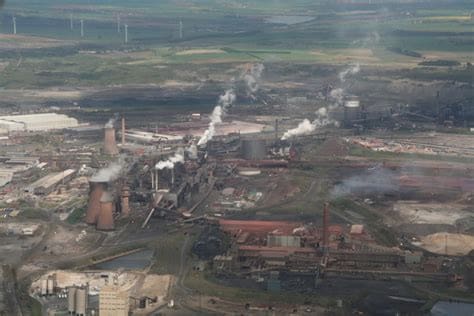
By the late nineteenth and twentieth centuries Scunthorpe had become synonymous with steel. Large integrated works grew along the eastern side of the town, transforming fields into furnaces and drawing workers from across Britain and beyond. For many years, the steelworks gave Scunthorpe one of the highest proportions of industrial employment in the country.
Planners once promoted it as an “industrial garden town”, and you can still see that intention. The main roads are broad, the layout feels open, and there are generous swathes of parkland threaded through and around the housing. The steelworks are still operating, though modernization and global competition mean far fewer people work there than in the heyday. The furnaces remain, but the payroll is thinner, and that change shapes a lot of local life.
Estates, Diversity and Everyday Life
Scunthorpe today is a patchwork of housing estates, parades of shops, older terraced streets and newer cul-de-sacs. It has the feel of a practical town that grew to meet demand rather than to impress passing architectural critics. This is not a drawback if you live here. It simply means the nearest Co-op, school or bus stop usually comes before the nearest Instagram backdrop.
Demographically, the town is still predominantly White British, but it also has the largest British Asian community in Lincolnshire, with notable South Asian communities that settled around periods of industrial recruitment. The 2021 Census shows a population just over 81,000, with a slightly higher proportion of children and older residents compared with some national averages.
In practical terms, that means busy school runs, multigenerational households and a steady demand for health and social care services. It also means a mixture of churches, mosques and community centres, each providing its own version of support and social glue. Life here tends to turn around shifts, school timetables, match days and supermarket opening hours rather than grand seasonal festivals.
Parks, Halls and Museums: Things to Do in and Around Scunthorpe
Scunthorpe’s reputation often begins and ends with steel in the national imagination. On the ground, the balance feels different. Parks, museums and arts venues quietly occupy a lot of the civic energy. For current attractions, events and visitor information, the official Visit North Lincolnshire Scunthorpe guide is a useful starting point.
Normanby Hall Country Park
Just to the north of town, Normanby Hall Country Park offers 300 acres of parkland wrapped around a Regency mansion. Locals treat it as a place for Sunday walks, children’s playgrounds, summer events and the small pleasures of watching deer or wandering through a walled garden. It is one of North Lincolnshire’s headline attractions and gives the area a distinctly green escape that sits comfortably beside the smokestacks on the horizon.
The gardens, woodland trails and open lawns give residents and visitors a space to breathe that is the opposite of claustrophobic factory floors. That contrast is one of the town’s quiet strengths.
North Lincolnshire Museum and 20-21 Visual Arts Centre
Back in the centre, North Lincolnshire Museum in Oswald Road covers local history from prehistoric finds to the industrial era, including the story of iron and steel that reshaped the area. Exhibits range from archaeology to social history, with interactive displays that make it approachable for families rather than niche specialists.
A short walk away, 20-21 Visual Arts Centre occupies the shell of a former church in Church Square. Inside, you find rotating exhibitions of contemporary art and craft, a small shop and a café. It is a distinctly modern space set inside Victorian architecture, and it serves as one of the region’s main contemporary art venues.
Taken together, the museum and arts centre offer a reminder that Scunthorpe has more going on than shift changes and traffic reports.
Theatres, Music and Match Days
For live performance, two names dominate: The Baths Hall and The Plowright Theatre. The Baths Hall, a re-purposed former baths complex, hosts touring bands, comedians, tribute acts and community events. The Plowright Theatre, more intimate, handles drama, local productions and smaller gigs.
Sport also matters. Scunthorpe United, playing at Glanford Park, continues to pull in loyal supporters through good seasons and grim ones. Speedway fans head for Scunthorpe Scorpions meetings, and rugby and cricket share facilities at Heslam Park, where community initiatives sit alongside club fixtures.
All of this gives the town a rhythm of home fixtures, touring shows and charity nights that feels familiar to many medium-sized UK towns.
Parks, Lakes and Nature Reserves
Within the town, Central Park offers formal gardens, play areas and open lawns. To the south-east, Ashby Ville Nature Reserve wraps itself around a former sand and gravel pit, now a lake used by wildfowl, anglers and, in warmer months, the sort of people who cannot resist a paddle.
These green spaces are not dramatic national-park landscapes. They are simply well-used, everyday lungs for a town that has spent much of its modern life breathing industrial air.
Getting To and Around Scunthorpe
Scunthorpe’s location makes it more accessible than some might expect from a quick glance at a map.
By road, the M180 links the town to the M18 and the wider motorway network, providing straightforward routes towards Doncaster, Sheffield, Leeds and beyond. The A15 runs south towards Lincoln and north towards the Humber Bridge and Hull, while the A18 and A1077 connect Scunthorpe to surrounding villages and the ports further east.
By rail, regular services connect Scunthorpe to Doncaster, which acts as a major interchange for routes across the north of England. Direct trains typically reach Doncaster in around twenty-five minutes, with onward connections to cities such as Sheffield, Leeds and York.
For air travel, journeys often route through Doncaster Sheffield (while it operated), Humberside Airport or the larger hubs further afield, reached by a combination of road and rail.
In town, local bus services and relatively compact distances mean that many everyday trips sit within a short ride or drive. This is not a city built around trams or underground lines. It is a place where a car, bus pass or a decent pair of walking shoes usually do the job.
Work, Education and the Local Economy
Scunthorpe’s economy still leans heavily on manufacturing and logistics, with the steelworks forming the most visible symbol of that reliance. Warehousing, distribution centres, retail parks and service industries fill in many of the gaps.
Over recent decades, the town has felt the strain of deindustrialisation. As steel employment has shrunk, long-term health problems, lower skills and pockets of deprivation have become part of the local picture. Analysts describing post-industrial Britain often use Scunthorpe as a case study for what happens when a place built around one big employer is asked to reinvent itself with limited resources and uneven national attention.
At the same time, there is slow, unglamorous work going on around education and training. Further-education colleges, apprenticeship schemes and adult learning centres all try to help people move from heavy industry into broader technical, health and service roles. The progress is not dramatic. It is incremental and often invisible from outside, which is probably why it rarely finds its way into the headlines.
The Famous Name Problem
For many people who have never visited, Scunthorpe is known mainly because of an unfortunate quirk of content-filtering history. In the mid-1990s, an over-enthusiastic profanity filter blocked residents from creating AOL accounts because the town’s name contained a banned four-letter substring. Similar filters later tripped up around search engines and other online services, and the incident eventually gave its name to the “Scunthorpe problem” in computing.
The episode now sits in textbooks and conference talks as a neat illustration of why blunt filtering rules cause chaos for innocent words and place names. For the town, it added an odd extra layer to its identity: industrial hub, steel town, and accidental global example in the story of how the early internet tried, and failed, to understand human language.
It is difficult to think of many other places whose main marketing challenge is that their name keeps getting mistaken for something rude by software. Scunthorpe has simply learned to live with it.
Layered Streets, Lasting Character
Scunthorpe is not a resort, and it does not pretend to be. It is a working town with a big industrial spine, some surprisingly generous green spaces and a network of modest cultural and sporting venues that keep people occupied between shifts and school terms.
We see a place whose history, from Norse farmstead to steel powerhouse, still shapes its streets and prospects. We see parks and country estates providing fresh air at the edge of heavy industry. We see a community dealing with economic headwinds while also running museums, galleries, theatres and football clubs.
If you arrive with expectations set by lazy punchlines or old headlines, the town feels different on the ground. It is quieter, more ordinary, more layered. It is the kind of place where people get on with things: clocking in, walking dogs around lakes, queuing for gigs at The Baths Hall, and taking children to see deer at Normanby Hall.
In that steady, unshowy routine sits the real character of Scunthorpe, and it is the sort of character that tends to last.
Scunthorpe’s industrial identity is very different from a southern market town, but this look at everyday life, local trade and public space in Kingsbridge makes a useful comparison with the way work, landscape and community shape a town.